

What does a “green” label actually tell you about how your clothes are cleaned? When choosing garment care, it’s reasonable to want clear information about the process and how delicate items are handled. If you’re comparing non-toxic dry cleaning Santa Monica options, start with the service’s specific description rather than relying on a label alone.
Terms such as “non-toxic,” “organic,” and “eco-friendly” can refer to different attributes. By themselves, they don’t identify a cleaning method or explain how a garment will be handled. Understanding that distinction makes it easier to compare services and decide what information matters for your clothes.
This guide explains common garment-care descriptions, offers practical points to consider for different items, and outlines how to arrange local dry cleaning. Laundry Breeze serves Santa Monica with dry cleaning and FREE pickup and delivery, so you can fit garment care into your routine without making a separate trip.
Key Takeaways
- Compare descriptions of cleaning methods instead of treating broad labels as proof of a particular process.
- Use process details as a starting point, not as automatic evidence about health effects, residues, or environmental impact.
- When comparing non-toxic dry cleaning Santa Monica options, weigh process information, garment handling, and convenience separately.
- Before arranging garment care, read each care label, point out stains, and set delicate pieces aside.
- Laundry Breeze’s FREE pickup and delivery can make local dry cleaning easier to fit into your routine.
What does non-toxic dry cleaning mean for Santa Monica customers?
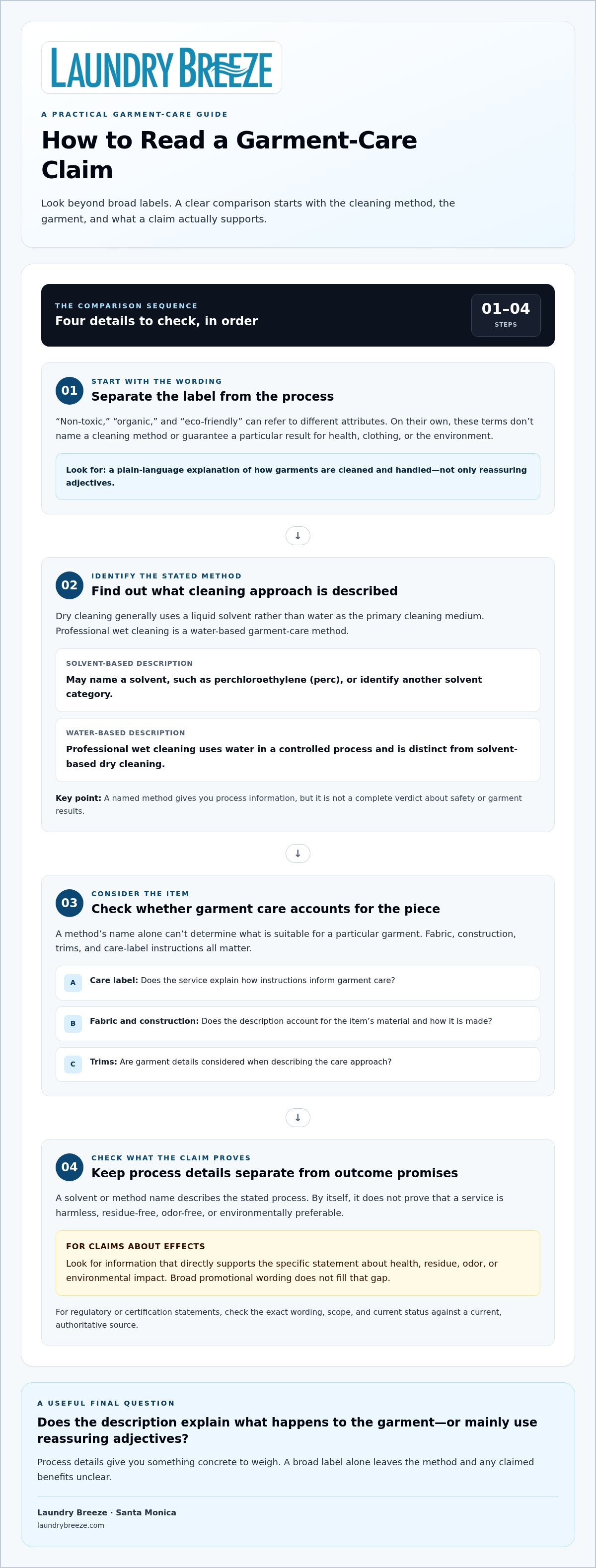
“Non-toxic dry cleaning” is a broad description for garment-care services presented as avoiding or reducing certain chemical hazards. The phrase alone does not identify the cleaning process or establish a specific health or environmental outcome.
That distinction matters when comparing non-toxic dry cleaning Santa Monica services. A label may signal how a service presents itself, but it doesn’t explain how clothes are cleaned, what substances are involved, or how an item is handled. A description of the process gives you something concrete to assess; a broad claim doesn’t answer those questions by itself.
How do non-toxic, organic, and eco-friendly claims differ?
These terms can refer to different attributes, so don’t treat them as interchangeable. “Non-toxic” may describe a claimed safety profile, “organic” may refer to particular materials or ingredients, and “eco-friendly” can indicate a general environmental positioning. None of these words names a cleaning method or guarantees a particular result for your health, clothing, or the environment.
Look for a named process or a plain-language explanation of how garments are cared for. Dry cleaning generally means cleaning with a liquid solvent rather than using water as the primary cleaning medium. For background on the basics and common methods, see What is Dry Cleaning? A process name is more informative than a general label, though it still isn’t proof of a particular outcome.
What information helps Santa Monica customers assess a claim?
Useful service descriptions explain the method in understandable terms and describe how garments are handled. They may clarify whether the service uses a water-based or solvent-based method and how care instructions or fabric type inform garment care. These details help you understand what a claim refers to without reading more into it than the description supports.
Separate process information from promises about effects. A named solvent or method is a detail to consider, not proof that a service is harmless, residue-free, odor-free, or environmentally preferable. Claims about health, residue, or environmental impact need evidence that directly supports the specific claim. Broad promotional wording doesn’t fill that gap.
A useful comparison question is: does the description explain what happens to the garment, or does it mainly use reassuring adjectives? The first gives you details to weigh. The second may sound appealing, but leaves the method and any claimed benefits unclear.
Which dry-cleaning methods and solvent details should you understand?
Garment-care services may use different cleaning methods. Some rely on a liquid solvent, while professional wet cleaning uses water in a controlled process. The method can affect how a garment is treated, but suitability depends on the item’s fabric, construction, and care instructions. A broad “green” label doesn’t tell you which approach is used.
A named cleaning method describes an approach. An unqualified green claim gives no specific process detail and, by itself, establishes no health or environmental outcome. Focus first on what a service description says, then note what it leaves unanswered. A process name is useful information, not a complete verdict about safety or garment results.
What should you know about solvent descriptions?
Perchloroethylene, often called perc, is one example of a named dry-cleaning solvent. Other descriptions may identify a different solvent category or refer to a water-based method. A name tells you something about the stated process, but it doesn’t explain how a specific garment was handled or what residue or odor may remain. Don’t read a solvent name as automatic proof of either safety or harm.
Be cautious about absolute wording such as “chemical-free.” A solvent or process description doesn’t establish that no chemicals are involved, nor does it independently prove that a service is harmless. Look for an explanation specific enough to understand what the claim means.
When might wet cleaning be relevant?
Professional wet cleaning is a water-based garment-care method, distinct from solvent-based dry cleaning. It may suit some items, but it isn’t right for every garment. Fabric, construction, trims, and care-label instructions all matter. The name of a method alone can’t determine the best care for a particular piece.
Before comparing non-toxic dry cleaning Santa Monica options, look for clear process language and separate it from promises about outcomes. That makes it easier to understand what a service description does and doesn’t tell you.
- Process: Does the description name a method, or rely only on broad green wording?
- Garment: Does the care approach account for the item’s label, fabric, and construction?
- Claim: Is a statement about health, odor, residue, or environmental impact supported by information specific to that outcome?
How can you compare non-toxic dry cleaning options in Santa Monica?
A green-sounding label can’t answer every care question. Compare the information behind each service description: what it says about the cleaning method, how it describes garment handling, and how easy it is to arrange care. Keep convenience and process transparency separate. Pickup and delivery can save an errand, but it doesn’t tell you which cleaning method is used.
Use the framework below to organize your comparison. A clear explanation is more useful than a label alone. If a detail is missing, treat it as unknown rather than filling in the gap with an assumption.
| Process disclosure | Garment handling | Convenience |
|---|---|---|
| Does the description name a method or explain it in plain language, rather than relying only on broad terms such as “green”? | Does it explain how care instructions, fabric, or garment construction inform handling? | Are local service details and pickup or delivery options easy to understand? |
| Does the explanation distinguish process details from promises about health or environmental effects? | Is the service scope described clearly enough to understand what garment care involves? | Can pickup and delivery simplify arranging garment care around your routine? |
Which questions help clarify garment-care practices?
Look for practical details in the service description: how garments are assessed, whether care-label instructions guide handling, and what the service includes. Plain language makes those details easier to compare. A process name may clarify the method, but it doesn’t answer every question about a particular item or establish a specific result.
For a useful comparison, sort information into two groups: what’s stated and what’s implied. A named method or an explanation of garment handling is a stated detail. Words suggesting that clothes will be safer, fresher, or better for the environment are outcome claims, not process descriptions. Keep those categories separate as you weigh your options.
How should you weigh convenience against process transparency?
Convenience matters, especially when a drop-off and collection trip is difficult to fit into your day. Laundry Breeze serves Santa Monica with dry cleaning and FREE pickup and delivery, which can reduce the errands involved. That service feature is about access, not evidence of a particular solvent, cleaning method, or health outcome.
When comparing non-toxic dry cleaning Santa Monica options, don’t let a single word make the decision. Identify what’s clearly described, what relates only to convenience, and what a label leaves unanswered.
What should you do before sending garments for dry cleaning?
A little preparation can make garment care clearer and easier to arrange. Before setting clothes aside, review each care label, point out visible stains, and separate delicate pieces so their instructions are easy to notice. These steps provide useful context, but they can’t guarantee a particular cleaning result.
How do you prepare delicate or stained garments?
Start with the care label. Check the instructions before arranging care, especially for garments with delicate fabric, linings, buttons, or other construction details. If you’re unsure how to group an item, keep it separate so it doesn’t get overlooked in a general pile.
Next, identify stains and share what you know about them. A coffee mark, makeup, or an unknown spot may need different attention, so point it out and describe its source if you know it. Mention any home treatment you’ve already tried, such as blotting or applying a product. Before trying another treatment, consider the garment’s care label. Stain removal depends on the fabric and the mark, so preparation can’t guarantee a specific result.
- Check: Read the care label and note any special instructions.
- Separate: Set delicate or unusually constructed pieces apart so they’re easy to identify.
- Identify: Point out stains and describe what caused them, if known.
- Explain: Share any prior treatment to provide context about the garment.
- Empty: Check pockets and remove personal items before handing garments over.
How can pickup and delivery simplify local dry cleaning?
Pickup and delivery can make garment care easier to fit into your routine by removing the need for a separate drop-off and collection trip. Laundry Breeze offers FREE pickup and delivery for dry-cleaning convenience. It’s an access option, separate from questions about cleaning methods or garment outcomes.
How Laundry Breeze makes Santa Monica dry cleaning easier
After comparing process descriptions and garment-care details, choose an option that fits your routine. Laundry Breeze offers dry cleaning in Santa Monica, with FREE pickup and delivery to make arranging garment care easier. This can remove a separate trip while keeping your evaluation of process claims grounded in the details available.
What can customers expect from a local dry-cleaning service?
Keep the decision points distinct. A local service option tells you where and how you can arrange care. It doesn’t, by itself, establish a particular solvent, cleaning method, certification, or non-toxic process. Use the process and garment-handling information discussed earlier to evaluate those claims, and consider pickup and delivery separately as a convenience feature.
Before arranging service, it can help to have the basics ready:
- Set aside the garments you want cared for.
- Keep relevant care-label details and garment notes easy to share.
- Identify stains or prior treatments you want to mention.
- Decide whether pickup and delivery would make the errand easier.
How do you take the next step in Santa Monica?
Start by reviewing the garment-care information and deciding which items you’d like to send. If pickup and delivery suits your routine, explore the service on the website and arrange your order. Keeping garment notes nearby can make it easier to share care instructions or concerns as you set things up.
Choosing non-toxic dry cleaning Santa Monica starts with understanding what service descriptions do and don’t tell you. Weigh process information, garment handling, and convenience as separate factors instead of relying on a broad label alone.
Choose garment care with confidence
You don’t need to decode every marketing phrase to make a thoughtful choice. Decide which details matter most for your garments, then use those priorities whenever you arrange care. Clear process information can help you understand a service description, while convenience can make the practical steps easier. Keeping those considerations separate makes the decision more manageable.
For non-toxic dry cleaning Santa Monica, aim for an informed choice rather than relying on a promise based on a label alone. Consider the information available about garment care and choose a local option that fits your routine.
Frequently Asked Questions
Is non-toxic dry cleaning completely chemical-free?
Not necessarily. The phrase alone doesn’t identify the cleaning method or establish that no chemicals are involved. If a service description uses this wording, look for an explanation of what it means, such as a named process or specific garment-care details. Consider health or environmental statements separately. A broad label may describe how a service is positioned, but it isn’t proof of a particular outcome.
What does non-toxic dry cleaning mean?
It usually signals a preference for an approach described as lower-toxin or more environmentally considerate, but the phrase doesn’t specify how clothes are cleaned. For example, when comparing services for a work jacket, look for a process description rather than relying only on “organic” or “eco-friendly.” Similar-sounding labels can refer to different things, so read the explanation attached to each claim before deciding what it means for your garment.
Is dry cleaning safe for delicate clothes?
It depends on the garment, its construction, and its care instructions. A lined jacket, for example, may need different consideration from a simple garment made from the same outer fabric. Check the label and mention details such as delicate trim, visible stains, or previous treatment when arranging care. No cleaning method suits every item, and a broad “non-toxic” label can’t determine the right approach for a particular piece.
Can I get dry cleaning with pickup and delivery in Santa Monica?
Yes. Laundry Breeze serves Santa Monica with dry cleaning and FREE pickup and delivery, which can help when fitting a laundromat visit into your routine is difficult. Review the service information on the website to arrange care.
How do I choose a non-toxic dry cleaner in Santa Monica?
Start with the details that matter for your garments: the described cleaning method, how items are handled, and what evidence supports any health or environmental claims. Compare services on the same points instead of treating similar labels as equivalent. Make a short checklist of care needs, such as delicate construction or a known stain, and consider local access and pickup convenience separately.
Does eco-friendly dry cleaning mean the same thing as organic dry cleaning?
Not necessarily. The terms may refer to different aspects of a service, and neither names a specific cleaning method by itself. Seeing “organic” on a service description, for example, doesn’t tell you how a particular jacket is cleaned. Look for the explanation attached to the label, and don’t assume either term means chemical-free, suitable for everyone, or better for the environment without supporting details.
Should I check the care label before sending clothes to a dry cleaner?
Yes. The label is a useful reference for the garment’s care instructions and can help you flag items that need attention. Note any instructions printed inside a jacket or along a seam before packing the garment. Also mention visible stains, delicate details, or previous treatments when arranging service. These details provide context, but they can’t guarantee a specific cleaning result.
To see links to services mentioned in this article, please click
https://www.laundrybreeze.com


