

Cleaning muddy sports uniforms in Beverly Hills takes more than lifting dirt. You also want to keep the lettering and numbers in good shape. Professional athletic uniform cleaning can tackle mud while accounting for the garment’s fabric and printed details.
Mud and grass stains can be stubborn, and the wrong cleaning approach may put delicate graphics at risk. This article covers two options: professional cleaning for athletic uniforms and turning jerseys inside out to help protect their lettering and numbers. See what each approach can do and why careful handling matters when a jersey needs to be ready for the next game.
Key Takeaways
- Professional cleaning can help lift muddy stains while accounting for the uniform’s fabric and condition.
- Turn a jersey inside out to help protect its lettering and numbers in the wash.
- How muddy the uniform is and what care it needs can shape a professional cleaner’s approach and turnaround.
- See whether Laundry Breeze’s Dry Cleaning Service could be a convenient next step for those muddy sports uniforms.
1. Professional athletic uniform cleaning
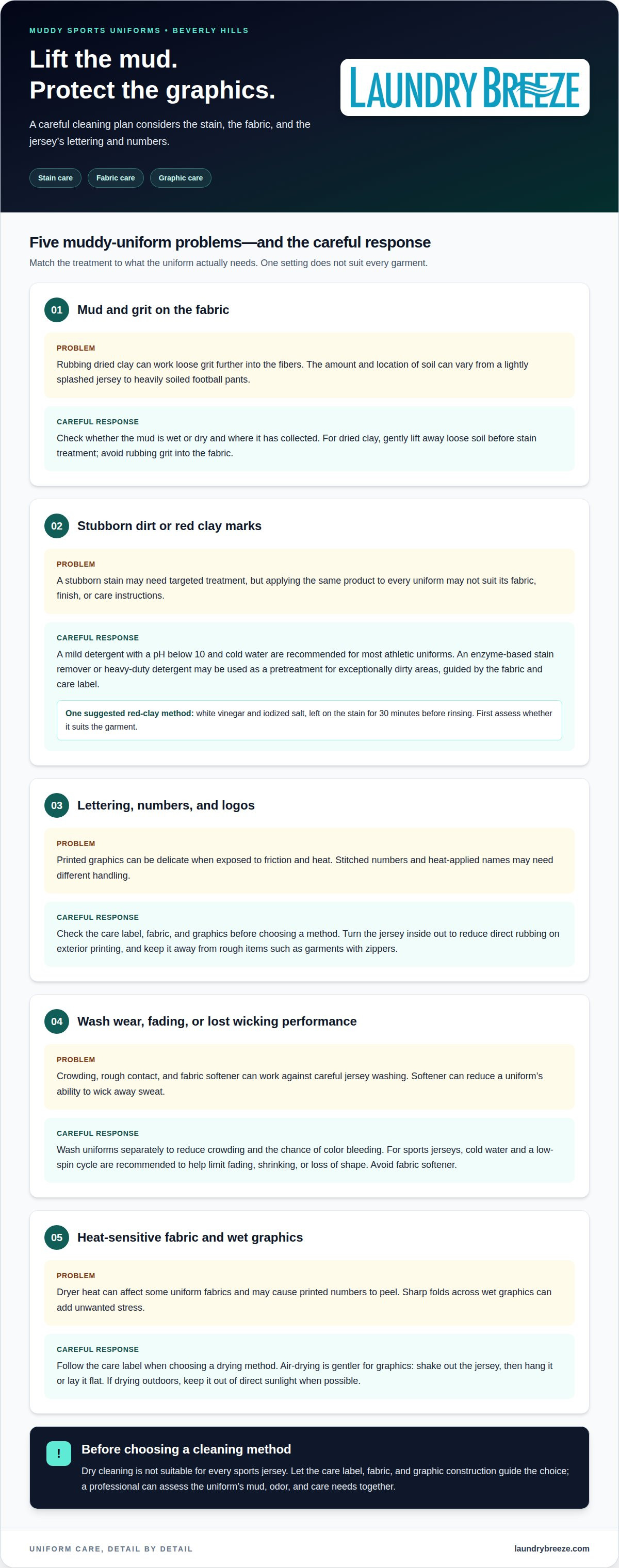
Polyester uniforms need stain treatment suited to their fabric and finish. Check whether mud is wet or dry, where it has collected, and whether the garment has printed graphics. For dried clay, gently lift away loose soil rather than rubbing grit into the fibers. Heavily soiled football pants and a lightly splashed baseball jersey may need different care, uniforms are not all in the same league.
Which detergents and stain treatments do professionals use for polyester sports uniforms? A mild detergent with a pH below 10 and cold water are recommended for most athletic uniforms. For exceptionally dirty areas, an enzyme-based stain remover or heavy-duty detergent can be used as a pretreatment, with the fabric and care label guiding the choice.
Red clay can leave stubborn marks, so targeted treatment matters. One suggested method uses white vinegar and iodized salt on dirt or clay stains, allowing the treatment to sit for 30 minutes before rinsing. A professional can assess whether that approach suits the garment instead of applying the same product to every uniform. Bleach is not a default choice for colored polyester; check the uniform’s color and care instructions before considering any bleaching treatment.
Washing technique also affects the result. Cold water helps care for athletic fabric, while washing uniforms separately reduces crowding and the chance of color bleeding. Fabric softener is generally avoided because it can reduce a uniform’s ability to wick away sweat. Odor treatment may be part of the process, but adding vinegar to a wash is different from targeted stain treatment. A careful cleaner considers odor, mud, and fabric together instead of expecting one treatment to tackle every problem. Mud, after all, does not come with a single-setting button.
After washing, air-drying can help avoid exposing laminated lettering and numbers to dryer heat. Separate garments by color and soil level, and follow the care label when choosing a wash and drying method. These steps help clean mud while treating a team uniform with more care than an ordinary shirt.
Heat exposure can affect some uniform fabrics, so follow the care label when choosing a drying method. In other words, heat is a factor to consider, not just a button to press. A professional can keep the uniform’s stretch in mind while selecting a drying method and follow its care instructions. If the garment has already been cleaned, letting it dry without added heat is a prudent way to avoid putting more heat stress on the spandex. This complements stain removal: removing soil is not the only aim, since preserving the garment’s fit and movement matters too. A cleaner should account for fiber content alongside visible dirt and printed details when planning care.
2. How professional cleaners protect lettering and numbers on jerseys
Printed names and numbers can be delicate during washing, especially when heat and friction get involved. A professional first checks the jersey’s care label, fabric, and graphics. That quick inspection helps determine the cleaning method before the garment takes a spin in the washer. Stitched numbers and heat-applied names may need different handling, after all.
Turning a jersey inside out is a simple way to protect exterior printing during washing. This puts the lettering against the garment instead of rubbing directly against other clothes or the washer drum. A cleaner can also keep the jersey away from rough items, such as garments with zippers, those little metal teeth aren’t exactly gentle on graphics. These small choices help reduce unnecessary contact with printed areas.
Can dry cleaning damage athletic fabrics, logos, numbers, or team lettering? The right method depends on the care label, fabric, and how the graphics are made. Dry cleaning isn’t suitable for every sports jersey, so check the garment’s instructions before choosing a service.
Water-based washing needs a little care, too. Cold water and a low-spin cycle are recommended for sports jerseys to help limit fading, shrinking, or loss of shape. Don’t crowd the washer: clothes rubbing together can make it harder for water and detergent to move through the load. Fabric softener is best avoided because it can affect moisture-wicking performance.
Grass stains need attention, but aggressive scrubbing over printed areas is best left off the playbook. A professional can target the stained fabric while avoiding unnecessary abrasion over a number or logo. If dirt has dried, gently remove loose soil before treatment to keep grit from spreading during washing. Choose a stain treatment that suits both the stain and the jersey’s care instructions.
Drying matters just as much as washing. Dryer heat can cause printed numbers to peel, so air-drying is gentler. Shake out the jersey and hang it or lay it flat, avoiding sharp folds across wet graphics. If drying outdoors, keep it out of direct sunlight when possible, your jersey doesn’t need a sunburn.
3. Where can I get muddy sports uniforms cleaned in Beverly Hills, CA?
Choose a laundry service that handles uniforms and considers fabric, mud, and printed details. For muddy sports uniforms in Beverly Hills, check that the service covers your neighborhood and explain the garment’s care needs. Clay, grass, stitched names, and printed numbers all matter, uniforms have plenty going on.
Start by describing the uniform. A polyester soccer jersey with heat-applied lettering may need different care from a cotton warm-up shirt, while baseball pants with red clay present another challenge. Share the garment type, known fabric, stained areas, and lettering style when arranging service.
Clear intake details help identify what needs attention. Point out visible stains, care instructions, logos, and numbers. Mud on a sleeve is different from soil worked into baseball pants. If several teammates have similar jerseys, identify each garment to avoid confusion.
Consider service details alongside customer ratings. Reviews can provide context about communication, but they don’t explain how a particular jersey will be handled. Descriptions that address uniforms, stain treatment, and garment care are more relevant to this job. For muddy sports uniforms in Beverly Hills, local service information can also help you understand whether a provider serves your neighborhood.
When arranging the cleaning, identify each garment if several look alike. Point out old stains, delicate patches, and spots treated previously. Those details can help distinguish similar jerseys and inform the cleaning approach. Mentioning a uniform’s game date can also help communicate when you need it back.
A uniform needed for an upcoming game has different timing needs from one being cleaned after the season. Share when you need it and describe its condition. Soil, fabric, graphics, and the cleaning method all affect the work involved.
Laundry Breeze serves Beverly Hills, as well as Los Angeles, West Hollywood, Culver City, Santa Monica, Venice, and Westwood. When arranging uniform cleaning, describe the fabric, graphics, and stains. Those details help explain what needs attention, whether it is a muddy football top, grass-stained baseball uniform, or a set of team garments.
4. How quickly can Beverly Hills cleaners clean muddy uniforms?
Cleaning time depends on the soil, fabric, care instructions, and method needed. Surface mud on a practice shirt differs from dried clay worked into baseball pants. A jersey with printed numbers also needs careful handling to protect its graphics. These factors shape the cleaning and drying process.
Stain condition affects the work involved. Fresh mud may be easier to remove than clay dried into the weave. Loose soil may need to be lifted before the stained area is treated, and some marks may need further attention. Grass and clay stains can require separate treatment rather than one quick wash. Mud, it turns out, does not always follow the team’s schedule.
Fabric and construction also matter. A lightweight polyester jersey, lined football top, and uniform with stitched patches have different care needs. Follow the care label and account for lettering, numbers, and attached details when choosing how to wash and dry each garment.
Drying adds time. Athletic uniforms should be fully dry before going back into a gym bag or team kit. Air-drying can take longer than machine drying, but avoiding heat can help protect laminated lettering and numbers. A deadline should not mean skipping complete drying or using a method that risks the graphics.
For a useful estimate, describe the job clearly when arranging service. Name the sport, point out stained areas, and share when the uniform is needed. “Baseball pants with dried red clay, needed before Saturday’s game” gives more context than “dirty uniform.” Include care instructions when available.
Several uniforms can affect scheduling. One muddy jersey is different from a team set with mixed colors, stains, and sizes. Group similar garments and identify special care instructions so they are not overlooked. The number of pieces and the condition of each one shape the workload.
Plan around the entire process, not just the wash cycle. A professional needs time to assess stains, clean the fabric, and let the uniform dry fully. If a game date is approaching, share that deadline early and describe any delicate lettering. Clear information helps set realistic expectations while giving the uniform the careful treatment it needs.
5. How can cleaners care for team uniforms?
Uniform cleaning involves more than a wash cycle. The garment needs to be assessed, stains treated, and the fabric cleaned and fully dried. A soccer jersey with light surface mud differs from baseball pants with dried clay, and the number of garments and their care needs affect the work.
Share your preferred pickup date when arranging service. “Ready before Thursday’s away game” gives the cleaning team a practical target. Include the date and time you’d like the uniform back, not only the next game day. That detail helps clarify whether cleaning, drying, and any needed inspection fit the schedule.
Describe the garments clearly. Name the sport, identify the uniform pieces, and point out mud, grass, or odor. For example, mention whether a set includes a jersey, pants, and socks, or only one shirt. If several players’ uniforms look alike, separate them by player or team before handoff. A little labeling can save everyone a game of “Whose jersey is this?”
Care instructions can affect the cleaning plan. A garment with printed numbers, patches, or delicate trim may need gentler handling than plain practice clothes. Share any label instructions and explain which pieces have special details. The cleaner can then account for those requirements from the start, instead of discovering them after cleaning begins.
Drying is part of the schedule, not an optional final touch. A uniform should be fully dry before it goes back into a bag or gets packed for a game. If a jersey requires air-drying to protect its graphics, that step can take longer than a heated drying cycle. Allowing time for this helps keep garment care on track.
For a team order, organize garments before drop-off. Group each player’s jersey and pants, point out unusually muddy pieces, and identify different care labels. One heavily soiled uniform may need different attention from the rest. This gives the cleaning team a clearer picture of the order, and keeps the muddiest pants from stealing the spotlight.
Ask for a realistic completion estimate based on the number of garments, stain condition, and drying needs. If a uniform is needed for an upcoming match, share the timing early. The aim is a clean, dry garment ready to wear, not just a completed wash cycle.
Laundry Breeze: Dry Cleaning Service
Laundry Breeze offers a Dry Cleaning Service for garments whose care labels call for dry cleaning. Got a muddy sports uniform? Check its fabric, soil, and attached lettering before choosing a method. Share the care instructions and point out any clay, grass, or delicate printed details, those little details matter.
For team uniforms, Laundry Breeze offers Commercial Laundry Service. For individual garments, Pickup & Delivery Laundry Service is a convenient option. When arranging service, describe the garments and their care needs, so your uniform can get the right kind of cleanup.
Make uniform care part of the team routine
For muddy sports uniforms in Beverly Hills, gather the garments after a game, check any special care instructions, and choose a laundry option that works for you. A simple routine can keep uniform care from turning into a pre-practice scramble, and save everyone from a last-minute jersey hunt.
Laundry Breeze offers Commercial Laundry Service for business laundry and Pickup & Delivery Laundry Service for added convenience. It also offers Comforter & Pillow Laundry Service for household bedding. Pick the service that fits the items you need cleaned.
Share what you need laundered, then take the next step whenever you’re ready.
A clean uniform is one less thing to worry about before your team’s next game.
Frequently Asked Questions
Which Beverly Hills laundromats or dry cleaners handle sports uniforms and heavy mud stains?
Laundry Breeze serves Beverly Hills with Commercial Laundry Service for uniforms and a Dry Cleaning Service. If your team or organization has multiple garments, the commercial option may be a good fit for ongoing uniform laundry needs. For one muddy jersey, the right service depends on the garment’s care requirements. When arranging service, let them know whether you’re bringing individual sportswear or a team’s uniform load.
Do Beverly Hills cleaners offer pickup and delivery for laundry?
Yes. Laundry Breeze offers FREE Pickup & Delivery Laundry Service in Beverly Hills, Monday through Sunday, from 9 a.m. to 7 p.m. Pickup and delivery can spare your household or team the adventure of transporting a pile of dirty uniforms. Include the number and type of items when arranging pickup.
What are the best-rated uniform cleaning services near Beverly Hills?
Choose a cleaner whose process addresses stain treatment, cold-water care, and jersey details; ratings alone may not tell the whole story. Check whether the service description explains how uniform cleaning differs from a regular load.
To see links to services mentioned in this article, please click
https://www.laundrybreeze.com


