

A gentler garment-care choice starts with the cleaning method and the products used, not just a green label. For eco-friendly dry cleaning in Santa Monica, wet cleaning is one approach to know about: the U.S. Environmental Protection Agency says its detergents and spot removers use ingredients described as safer for workers and the environment while still helping remove soils, stains, and odors.
It makes sense to want clothes cleaned well without overlooking the process. But terms like “eco-friendly” and “biodegradable” are most useful when you understand what they describe, so you can assess claims clearly.
This guide explains eco-focused garment care, what to look for in product and process descriptions, and how pickup and delivery can simplify laundry. You’ll also find practical guidance on service hours and customer feedback in Santa Monica, helping you choose an option that fits your garments and routine.
Key Takeaways
- Learn how wet cleaning and its cleaning products can support a more environmentally mindful garment-care approach.
- See how pickup and delivery can make garment care easier to fit into your routine.
- Understand what biodegradable product claims mean and what details can help you assess them.
- Use business hours and customer reviews to judge whether a service suits your schedule and expectations.
- Explore practical garment-care options for personal items and business laundry needs.
Environmentally focused dry cleaning and laundry
Garment care involves different methods, products, and handling steps. In Santa Monica, comparing those details helps distinguish a specific environmental practice from a broad green claim.
Cleaning Methods Beyond Perc
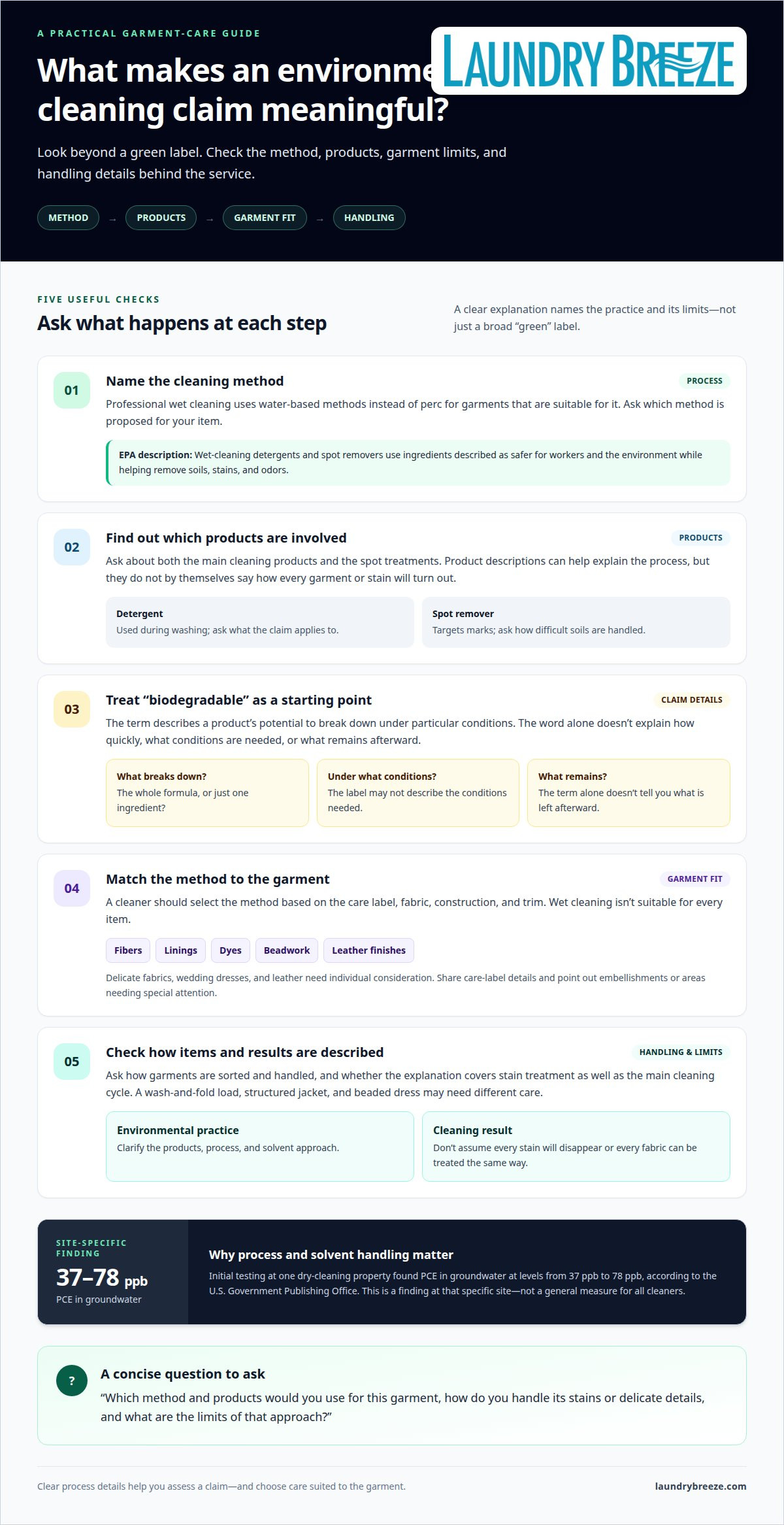
Professional wet cleaning uses water-based methods instead of perc for suitable garments. The U.S. Environmental Protection Agency describes wet-cleaning detergents and spot removers as using ingredients considered safer for workers and the environment, while helping remove soils, stains, and odors. A cleaner selects the method based on the garment’s care label, fabric, construction, and trim.
Environmental questions matter because solvent releases can affect more than the clothes being cleaned. At one dry-cleaning property, initial testing found PCE in groundwater at levels from 37 ppb to 78 ppb, according to U.S. Government Publishing Office. That site-specific finding illustrates why process descriptions should address solvent use and handling, not just the finished garment.
Delicate fabrics, wedding dresses, and leather need individual consideration. Wet cleaning isn’t suitable for every item: fibers, linings, dyes, beadwork, and leather finishes can affect the safest method. Before service, share the care-label details and point out stains, embellishments, or areas needing special attention.
Laundry and wash-and-fold services generally handle washable everyday items, while dry cleaning is for garments requiring another care method. Cleaning removes visible soil, but sanitation is a separate question. If a particular hygiene outcome matters, explain the intended use and ask which cleaning process applies to those items.
Evaluating Environmental Practices
Look for a clear explanation of the method used, the products involved, and how the cleaner decides which garments can be wet cleaned. A useful description names the process and its limits. A general “green” label alone doesn’t tell you whether a particular dress, coat, or stain will receive that treatment.
Check whether the process explanation covers stain treatment as well as the main cleaning cycle. Ask how difficult soils and delicate details are handled, and share the garment’s care label and stain history. These specifics help the cleaner choose a suitable approach rather than applying one method to every load.
Finally, distinguish environmental claims from claims about cleaning results. A process may describe its products or solvent approach without promising that every stain will disappear or every fabric can be treated the same way. Explain what the garment needs, then use the cleaner’s description to understand how it will be cared for.
Mobile dry cleaning and home delivery
Laundry Breeze offers pickup and delivery in Santa Monica, as well as nearby Beverly Hills and Culver City. The service can save you a trip, but pickup arrangements and garment-care methods are separate parts of the process.
“Mobile dry cleaning” usually means arranging garment pickup and return, not cleaning clothes inside a vehicle. The garments go to a cleaning facility, where their care instructions and condition guide handling. Home delivery changes how clothes move between you and the cleaner; it doesn’t identify the cleaning method or its environmental impact.
For a smooth handoff, prepare each garment clearly. Keep dry-clean-only pieces apart from household laundry, and group special items together. A jacket, dress, and washable shirt may need different care, so separating them helps clarify what belongs in each category.
- Keep garments with special care labels in a separate group.
- Point out visible marks and describe what caused them, if known.
- Include the pickup address and a clear handoff location when arranging service.
- Keep personal items, such as keys or receipts, out of garment pockets.
These steps make the order easier to identify and help prevent a delicate piece from being treated like everyday laundry. For example, identify a beaded dress as a special garment instead of bundling it with ordinary shirts. A note about a stain also gives the cleaning team useful context before treatment.
Service area matters as much as convenience. Laundry Breeze serves Santa Monica and nearby areas, including Beverly Hills and Culver City. Pickup and delivery are also available in Los Angeles, West Hollywood, Venice, and Westwood. Check that your address is within the listed service area when arranging pickup.
Delivery still takes practical planning. Choose a secure handoff spot and keep garments protected until pickup. If you live in a shared building, include useful entry or drop-off instructions when arranging service. Make the return location clear, too, so you can receive clean clothes without confusion.
Biodegradable cleaning products
“Biodegradable” describes a product’s potential to break down under particular conditions. The word alone doesn’t explain how quickly breakdown occurs, which conditions are needed, or what remains afterward. For example, a detergent label may use the term without saying whether it applies to the whole formula or just one ingredient. Treat the claim as a starting point, not a complete account of environmental impact.
Cleaning products can have different roles. Detergent works during washing, while a spot remover targets a mark such as coffee on a shirt. Their ingredients and uses differ, so an environmental description of one shouldn’t automatically be applied to every product in the process. A clear explanation identifies each product’s role and where it is used.
Read product claims in context. Check whether the wording describes one ingredient, the full formula, or the finished product. For example, “plant-derived” describes an ingredient source, while “biodegradable” describes breakdown potential. Neither phrase alone explains how the product performs on wool, silk, or a stained cotton shirt.
- Identify the claim: Separate “biodegradable” from terms about ingredient origin.
- Read the scope: See whether the statement applies to one ingredient or the whole product.
- Consider the task: A spot treatment and a wash detergent have different jobs.
- Keep fabric in view: A product’s environmental description doesn’t establish suitability for every garment.
Performance matters alongside product claims. A cleaner must match treatment to the stain, fabric, and care label. For example, a greasy mark on a washable cotton shirt calls for a different approach than a water-sensitive mark on a lined jacket. Stronger treatment isn’t automatically better: the fabric’s construction can affect which method is appropriate.
Product language doesn’t describe the entire cleaning operation. Garment care involves the cleaning agent, how it is applied, and how the item is handled afterward. A description focused on one ingredient may leave out other steps. Knowing the difference helps you evaluate environmental claims without assuming one label tells the whole story.
For an informed choice, compare specific wording rather than relying on a green image or broad promise. A product description that explains its purpose, scope, and use offers more context than a simple “eco” label. Apply the same careful reading to detergent, stain remover, and any product named in a garment-care explanation.
Business hours
Business hours shape when you can drop off clothes, speak with staff, or collect finished garments. For a Santa Monica cleaner, use the hours listed for the specific location, then plan around the service you need. A storefront schedule and a pickup window may describe different parts of the process.
Start by identifying the task. A walk-in drop-off depends on the location’s customer hours, while home pickup is arranged separately. For example, someone bringing in a jacket needs to visit when the counter is open. A household arranging collection needs to plan around the pickup window.
Look for the full weekly schedule, including differences between weekdays and weekends. If a listing shows separate opening and closing times by day, match your visit to that day rather than assuming one schedule applies all week. Note holiday hours separately when published, since the regular schedule may not apply.
Before leaving home, use this simple sequence:
- Choose the location you plan to use in Santa Monica.
- Read the schedule for the exact day of your visit.
- Match the service to its available handoff method.
- Allow time to discuss garment labels, stains, or special handling.
This matters for a wedding dress or a jacket with a visible stain. A quick handoff may leave little time to explain fabric details, so prepare the care label and your notes beforehand. For pickup, group the garments and have your handoff instructions ready for the scheduled window.
Business hours also affect how you organize your workday. If your schedule has a narrow opening, compare it with the posted customer hours before setting out. A lunch break, school run, or commute can help you decide whether drop-off or home pickup better suits your day. Keep the chosen day and handoff details together to avoid a last-minute scramble.
For businesses with towels, linens, or uniforms, operating hours affect how laundry handoffs fit into daily routines. A salon, for example, may need to coordinate linen collection around opening tasks. Separating items and noting the intended handoff time helps keep the exchange organized without interrupting customer service.
Use the schedule to plan, not as a promise about when each garment will be ready. Opening hours describe when a location receives customers; cleaning and return timing are separate details. Keeping those questions distinct makes it easier to plan a visit without assuming a convenient drop-off time means immediate collection.
Customer reviews
Customer reviews can offer insight into how a cleaner handles everyday service, special garments, and communication. Look for concrete examples instead of relying only on an overall rating. A review describing a stained blouse, pickup handoff, or staff guidance gives more context than “great service” alone.
For environmentally focused garment care, look for reviews that describe the process. A customer might mention wet cleaning, product explanations, or how staff handled a care label. Treat those comments as individual experiences, not proof that every garment receives the same method. A clear process description remains essential.
Sort reviews by date and read a mix of recent and older comments. This can show whether feedback mentions recurring strengths or changing experiences. For example, several detailed comments about careful handling may offer more insight than one brief compliment. Reviews reflect individual garments, stains, and expectations, so one account cannot describe every order.
Use a simple reading checklist:
- Service details: Does the reviewer describe dry cleaning, laundry, or pickup?
- Garment context: Is the example about an everyday shirt or a delicate dress?
- Communication: Does the review mention clear explanations or updates?
- Resolution: If a problem arose, does the reviewer explain how it was addressed?
Specific details matter. A comment about a wedding dress, for instance, may help you understand how staff communicate about delicate items. It doesn’t establish that every dress receives identical care. Likewise, a review of home delivery can describe the handoff experience, but not necessarily the cleaning method used afterward.
Look for balanced feedback, too. A review explaining what went well and what could have been clearer often gives more context than broad praise. If a customer describes a missed instruction or a stain that remained, note whether the review includes details about the garment and follow-up. This context helps you assess the experience without treating one review as a universal result.
Reviews can’t independently verify claims such as “biodegradable” or “eco-friendly.” Use them to learn about customer experiences, then compare those comments with the cleaner’s explanation of its products and methods. For example, praise for fresh-smelling clothes doesn’t identify the cleaning agent or establish its environmental properties.
Laundry Breeze: Dry Cleaning Service
For eco-friendly dry cleaning in Santa Monica, Laundry Breeze offers dry cleaning for garments that need professional care. It’s a practical option for workwear, occasion clothes, or pieces that aren’t suited to a regular laundry load.
Customers looking for eco-friendly dry cleaning in Santa Monica can also choose pickup and delivery for an easier handoff. Businesses with recurring towels, linens, or uniforms can use commercial laundry service, while comforter and pillow laundry handles bulky bedding.
Make Your Next Garment-Care Choice
Choosing eco-friendly dry cleaning in Santa Monica starts with matching the service to your garment and understanding the care process. Set aside the pieces that need attention, note any stains or delicate details, and choose a handoff that fits your day. A clear plan makes it easier to arrange garment care without adding another errand to your schedule.
Laundry Breeze offers pickup and delivery for convenient handoffs, commercial laundry for business items, and comforter and pillow laundry for bulky bedding. Choose the service that fits what you need cared for, whether it’s a garment at home or linens for your business.
Frequently Asked Questions
Which dry cleaners in Santa Monica offer eco-friendly or non-toxic cleaning?
Laundry Breeze offers dry cleaning in Santa Monica, and its service mission includes eco-friendly cleaning. “Non-toxic” is a separate claim, so don’t assume it means the same thing as environmentally focused care. For a silk blouse or lined jacket, share the care label and any special concerns when arranging service. This gives the garment’s specific needs helpful context.
Which Santa Monica eco-friendly dry cleaners have the best customer reviews?
There isn’t a substantiated basis here to rank Santa Monica cleaners by customer reviews. Star averages can combine feedback about different services, so look for comments about the type of care you need. For example, a review of a delicate dress may be more relevant to your occasion garment than one describing routine laundry. Reviews describe individual experiences, not a guarantee of your result.
What are the turnaround times and business hours for eco-friendly dry cleaners in Santa Monica?
Laundry Breeze pickup and delivery hours are Monday through Sunday, 9:00 a.m. to 7:00 p.m. Those hours describe the service window, not a garment’s completion time. Turnaround can depend on the item’s care needs, condition, and required handling. If you’re preparing clothes for a Santa Monica event, plan ahead so cleaning and return can fit your schedule.
To see links to services mentioned in this article, please click
https://www.laundrybreeze.com


