

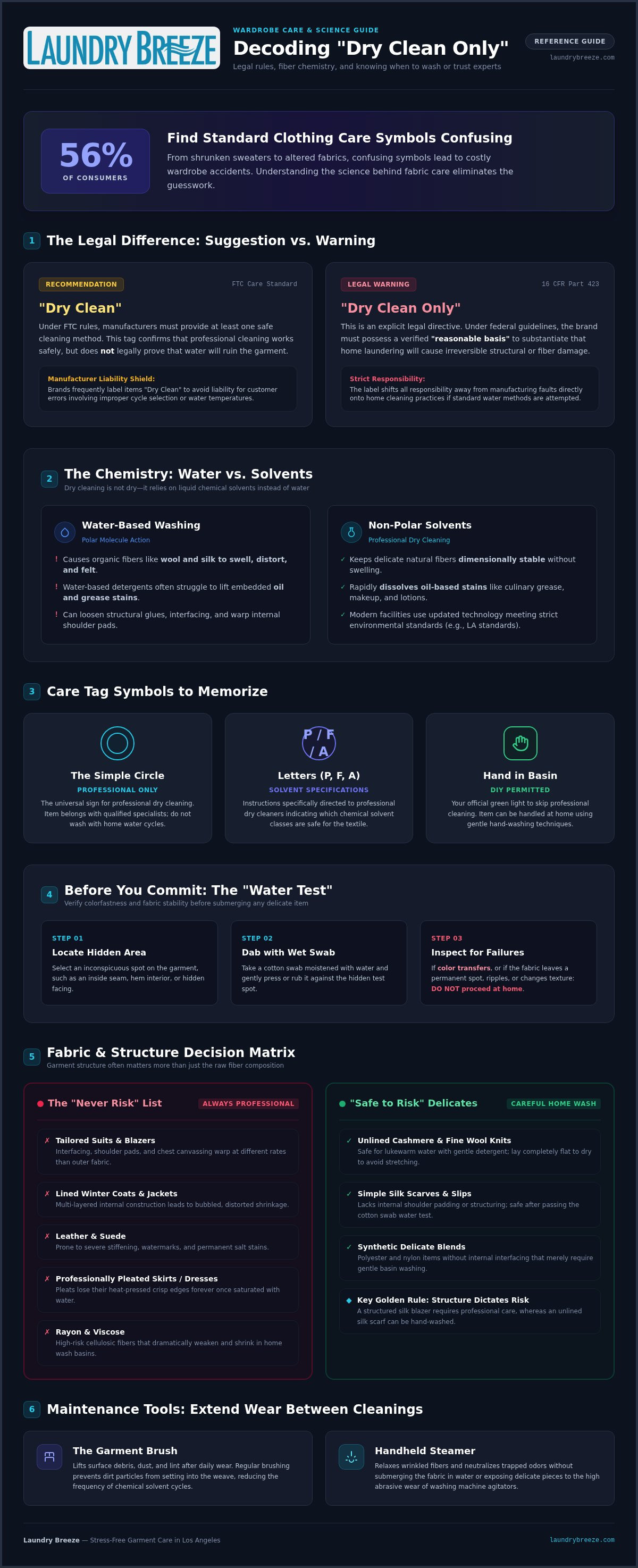
Have you ever pulled a favorite wool sweater out of the wash only to find it has shrunk enough to fit a teddy bear? It is a frustrating reality for the 56% of consumers who find standard clothing care symbols confusing. Learning how to care for dry clean only items does not have to feel like a high stakes gamble with your expensive wardrobe. Whether you are staring at a delicate silk blouse or a structured blazer, the "Dry Clean Only" label is often a manufacturer's safety net rather than a strict law. Knowing the science behind the fibers is the first step to saving your clothes and your sanity.
We understand the stress of deciphering laundry codes while trying to avoid another long trip through Los Angeles traffic. You want your favorite pieces to look fresh without spending your entire Saturday running errands. This guide will help you master the science of fabric care so you can confidently decide when to grab the basin and when to trust the professionals. We will show you which fabrics are safe for a gentle hand wash, how to extend the life of your garments between cleanings, and how to find a stress free solution that makes laundry day feel like a breeze.
Key Takeaways
- Learn the legal distinction between a "Dry Clean" suggestion and a "Dry Clean Only" warning to avoid unnecessary stress and expense.
- Discover how to care for dry clean only items at home by identifying "safe to risk" fabrics like unlined cashmere and synthetic delicates.
- Master the "Water Test" technique to check for colorfastness and prevent permanent damage before you start a home wash.
- Find out how simple tools like garment brushes and steamers can refresh your wardrobe and extend the time between professional cleanings.
- Identify the specific structured garments, such as tailored suits and lined coats, that always require expert care to maintain their shape and value.
Decoding the "Dry Clean Only" Label: Science vs. Suggestion
Every piece of clothing tells a story through its care tag. Under the Federal Trade Commission's Care Labeling Rule (16 CFR Part 423), manufacturers must provide at least one safe way to clean a garment. This means if a tag says "Dry Clean," the manufacturer has verified that professional cleaning works, but it does not necessarily mean water will ruin the item. However, when you see "Dry Clean Only," it is an explicit legal warning. In these cases, the brand must have a "reasonable basis" to prove that home laundering will cause damage. Understanding this distinction is the secret to knowing how to care for dry clean only items without causing accidental damage.
Why do brands often play it safe with these labels? Liability is the main reason. It's much easier for a clothing company to recommend professional cleaning than to risk a customer using the wrong water temperature or a harsh cycle. By labeling an item as "Dry Clean Only," the brand shifts the responsibility of care away from their manufacturing and onto the cleaning process. This helps them avoid returns from customers who accidentally shrunk a silk blouse or felted a wool sweater in a standard machine.
The Chemistry of Dry Cleaning
The name is a bit of a trick because dry cleaning is not actually dry. Instead of using water, the process involves immersing clothes in liquid chemical solvents. You can learn more about the dry cleaning process and fabric compatibility to see how these non-polar solvents interact with different textiles. While water causes certain fibers like wool or silk to swell and distort, solvents keep the fibers stable. These chemicals are also incredibly efficient at dissolving oil-based stains, such as grease or makeup, which water-based detergents often struggle to lift. For residents in Los Angeles, modern facilities have moved away from older, harsher chemicals to follow strict environmental regulations, ensuring your clothes are treated with safer, updated technology.
Common Laundry Symbols to Memorize
If you want to master how to care for dry clean only items, you need to speak the language of symbols. These small icons provide the blueprint for your garment's survival.
- The Circle: This is the universal sign for professional dry cleaning. If you see this, the item belongs at a professional dry cleaning service.
- Letters (P, F, A): These are instructions for the professional cleaner. They specify which types of solvents are safe for that specific fabric.
- Hand Wash: This symbol looks like a hand inside a basin of water. It is your official green light to skip the professional cleaner and handle the item yourself using gentle techniques.
Identifying these marks early prevents expensive mistakes. When you are unsure, always default to the professional recommendation to keep your wardrobe in top shape.
When You Can (and Can’t) DIY Your Delicates
Deciding whether to wash a garment at home or call in the professionals is a bit of a science. Learning how to care for dry clean only items starts with a simple choice: is the label a recommendation or a strict requirement? As we discussed, the FTC Care Labeling Rule requires manufacturers to list at least one safe method. If that method is dry cleaning, you might still have other options. However, your decision should depend more on the garment's structure than just the fabric type. A simple silk scarf is much easier to manage than a silk blazer with internal shoulder pads.
Before you commit to a sink full of water, always perform the water test. Dab a small, hidden area of the fabric with a wet cotton swab. If the color bleeds onto the swab or if the fabric leaves a permanent water spot, do not proceed at home. This simple check saves you from the heartbreak of a ruined investment. If the fabric ripples or changes texture, that is another clear sign that water is the enemy.
The "Never Risk" List
Tailored suits, blazers, and lined coats are almost never safe for home washing. These items contain internal layers called interfacing and padding that give the garment its shape. Water often causes these materials to shrink or warp at different rates than the outer fabric, leading to a bubbly, distorted mess. Professionally pleated skirts or dresses can also lose their crisp edges forever if they get wet. Leather and suede are strictly off limits because they are prone to salt stains and stiffening. Rayon and viscose are also high risk fibers. They are notorious for shrinking significantly or losing their soft texture when they hit water.
Fabrics You Can Often Hand Wash
Here is our golden rule: if you love the item and it is irreplaceable, don't wash it in your sink. The risk of shrinkage or fiber damage is real. Mastering how to care for dry clean only items means knowing your limits. It is better to spend a few minutes scheduling a pickup than to spend hours mourning a favorite outfit.
The Step-by-Step Guide to Hand-Washing at Home
If you have passed the water test mentioned in the previous section, it is time to set up your home cleaning station. Start with a pristine basin or sink. Any residue from household cleaners can damage delicate threads. Fill it with cool water. Cool is king here because heat is the primary cause of shrinkage for natural fibers. You must skip the standard detergent. Most grocery store soaps contain aggressive enzymes designed to eat away organic stains, but they will also eat through the protein in your silk or wool garments. Instead, opt for a pH-neutral delicate wash. Understanding why clothes are marked dry clean only helps you realize that these fibers are sensitive to chemical changes.
Once your garment is submerged, follow the "Agitate, Don’t Scrub" rule. Swirl the item gently through the water like a tea bag. Scrubbing creates friction that can pill the surface or break delicate fibers. After a few minutes, drain the basin and rinse with fresh, cool water until the soap is gone. Never wring or twist the fabric to remove water. This is where most DIY attempts fail. Instead, use the "Towel Roll" technique. Lay the wet item flat on a clean towel, roll it up like a sleeping bag, and press down firmly to absorb the moisture.
The Tools You Need for Home Care
The Drying Process: Patience is a Virtue
Drying is the final hurdle in learning how to care for dry clean only items at home. Avoid direct sunlight at all costs. While the LA sun is great for a beach day, its UV rays will fade silk and wool faster than you think. Lay your item flat on your rack in a well-ventilated area. Reshape it while it is damp to ensure it dries in its original silhouette. Most importantly, keep it far away from the dryer. The high heat and tumbling action are the absolute enemies of structured clothing.
Maintenance Between Cleanings: Making Your Clothes Last
The secret to a long lasting wardrobe is reducing the frequency of full cleaning cycles. Every time a garment is submerged in solvent or water, the fibers undergo a small amount of stress. Mastering how to care for dry clean only items means becoming a pro at daily upkeep. Start by giving your clothes "rest days." Natural fibers like wool and silk need at least 24 hours to shed moisture and return to their original shape after being worn. If you wear the same blazer two days in a row, the fibers never get a chance to recover; this leads to premature wear and sagging.
Brushing is another essential habit for garment longevity. Use a natural bristle garment brush to sweep away dust, skin cells, and hair before they settle into the weave. This simple 30 second task prevents dirt from becoming permanent. For minor mishaps during a Beverly Hills lunch, act fast with spot cleaning. Blot the spill immediately with a clean, dry cloth. Never rub the fabric. Rubbing pushes the stain deeper and can damage the delicate surface texture of the fibers.
Mastering the Garment Steamer
A handheld steamer is the most versatile tool for anyone learning how to care for dry clean only items at home. Steaming is much safer than ironing for delicate pieces. High heat from a traditional iron can crush fibers or create a permanent "shine" on wool. Steam uses gentle moisture to relax wrinkles while killing bacteria and removing odors. This is a perfect way to refresh a dress after a night out in West Hollywood. When steaming silk, keep the steamer head at least an inch away from the fabric to prevent water spots.
Smart Storage Solutions
Proper storage is your final line of defense against damage. Always remove your clothes from the thin plastic bags provided by a cleaner. Those bags trap moisture and can cause yellowing or mildew over time. Switch to breathable cotton garment bags instead. In Los Angeles, moths can be a year round problem in dark closets. Protect your investment by using cedar blocks or lavender sachets. These natural scents repel pests without the harsh chemical smell of traditional mothballs.
Professional Dry Cleaning: The Ultimate Convenience in LA
While mastering home techniques is a great way to handle basic wardrobe maintenance, there are moments when you should stop the DIY process and call in the experts. If you are dealing with stubborn oil-based stains, complex garment structures, or high-value designer pieces, professional care is the safest path. Knowing how to care for dry clean only items is about recognizing when a garment is beyond home treatment. Professional dry cleaning does more than just clean; it preserves the integrity of the fibers and extends the lifespan of your high-end fashion by using specialized equipment that home setups simply cannot match.
At Laundry Breeze, we understand that your wardrobe is an investment. Our facility is fully attended, meaning our staff is always present to follow your exact specifications for every garment. We use modern, eco-friendly processes that comply with California’s strict environmental standards, ensuring your clothes are treated with the highest quality care available in Los Angeles. You don’t have to worry about the confusion of laundry symbols when you have a dedicated team handling the details for you.
Why LA Professionals Choose Pickup & Delivery
Beyond Just Clothes: Bulky Item Care
Master Your Wardrobe Maintenance Today
You now have the knowledge to handle your most delicate garments with total confidence. By distinguishing between a helpful suggestion and a strict warning, you can save money and protect your favorite pieces from accidental damage. Remember that while hand-washing works for many natural fibers, structured items like suits always deserve expert attention. Using simple tools like a garment brush or steamer will keep you looking sharp between professional cleanings. Learning how to care for dry clean only items shouldn't be a chore that takes over your entire weekend.
Frequently Asked Questions
Can I use a "Dry Clean Only" kit in my home dryer?
Home kits are useful for refreshing clothes, but they don't provide a deep clean. They use a moist cloth and the heat of your dryer to remove wrinkles and light odors. Don't use them for structured blazers or coats because the tumbling action can warp the internal padding. While they are a quick fix, they can't replace the thorough results you get from a professional facility with modern equipment.
What happens if I accidentally wash a dry clean only item in the machine?
Accidentally washing a delicate item in a machine often leads to shrinkage or fiber damage. Natural fibers like wool can felt and become stiff, while silk may lose its characteristic luster. The mechanical agitation of a standard wash cycle is usually too harsh for fine threads. If this happens, don't put the item in the dryer. Lay it flat on a towel and try to gently reshape it while it's still damp.
How often should I actually dry clean my suits and dresses?
Most experts recommend cleaning suits every three to four wears. Over cleaning can actually damage the fibers and shorten the lifespan of your favorite pieces. Use a garment brush and a steamer between professional visits to keep things fresh. For those living near the coast in Santa Monica, airing out your clothes is vital to prevent moisture from settling. Learning how to care for dry clean only items means finding the right balance between wear and care.
Is steaming the same as dry cleaning?
Steaming is not the same as dry cleaning because it doesn't remove oils or deep dirt. It's a fantastic tool for removing wrinkles and killing surface bacteria between professional cleanings. However, steam uses water, which cannot dissolve the oil-based stains that solvents handle easily. Think of steaming as a daily refresh and dry cleaning as the deep treatment your high-end Los Angeles wardrobe needs to stay in peak condition.
Can I hand wash 100% silk if the tag says dry clean only?
You can often hand wash 100% silk even if the tag suggests professional care. Many brands use the label to avoid liability for improper home washing. If the item is unlined and passes a quick colorfastness test, a gentle dip in cool water with pH-neutral soap is safe. Just remember to avoid wringing the fabric. If you're unsure, it's always safer to trust an attended facility in Culver City to handle the job.
Why do some clothes smell after dry cleaning?
A lingering chemical smell usually means the cleaning solvent didn't evaporate completely during the drying process. In California, we've moved away from older, harsher chemicals to follow strict environmental rules. If your clothes have a strong scent, it might be a sign that the equipment used wasn't up to modern standards. At Laundry Breeze, we use updated technology to ensure your garments come back smelling fresh and clean every single time.
How much does it cost to dry clean a dress in Los Angeles?
Prices for garment care in the Los Angeles area depend on several factors like fabric type and garment complexity. A simple shift dress will cost less than a formal gown with layers of silk or delicate beadwork. Many mobile services in Beverly Hills also have a minimum order requirement for delivery. We recommend checking our service page to see how we price different items to ensure you get the best value for your wardrobe.
Does dry cleaning remove all types of stains?
Professional cleaning is excellent for lifting oil-based stains like grease, makeup, and body oils. However, water-based stains like red wine or coffee may require specialized pre-treatment to fully disappear. Always point out specific spills when you drop off your items. Our attendants know how to care for dry clean only items by selecting the correct spotting agents for every unique fiber type, ensuring the best possible results for your clothes.
To see links to services mentioned in this article, please click
https://www.laundrybreeze.com


