
What if the heat in your dryer isn't the only reason your favorite designer sweater just turned into a crop top? Shrinkage is actually a three-pronged attack of heat, moisture loss, and mechanical stress. It's a frustrating reality for the 54% of Americans who already rank laundry as their top household annoyance. If you're tired of losing money on ruined clothes and feeling confused by complex care tags, you need a reliable strategy for how to prevent clothes from shrinking that doesn't require hours of air-drying every single item.
We believe laundry should be a breeze, not a source of stress. You've worked hard for your wardrobe, and you deserve a routine that keeps every piece looking new without the guesswork. In this guide, you'll master the science of garment care and learn the exact steps to keep your clothes fitting perfectly wash after wash. We'll preview the high-risk fabrics to watch out for, explain the latest shifts toward digital QR care labels, and help you decide when to DIY versus when to call in the professionals.
Key Takeaways
- Understand the physical causes of fiber contraction and master the primary steps for how to prevent clothes from shrinking.
- Learn why "pre-shrunk" garments can still get smaller and which common DIY "unshrinking" hacks are actually worth your time.
- Discover the specific "zero-agitation" washing techniques needed to protect high-risk materials like wool, silk, and organic cotton.
- Identify the exact temperature settings and cycle types that keep your fibers relaxed and your colors bright.
- Explore how professional Wash & Fold services use commercial-grade precision to provide a level of care that home machines cannot match.
The Science of Shrinkage: Why Your Clothes Get Smaller
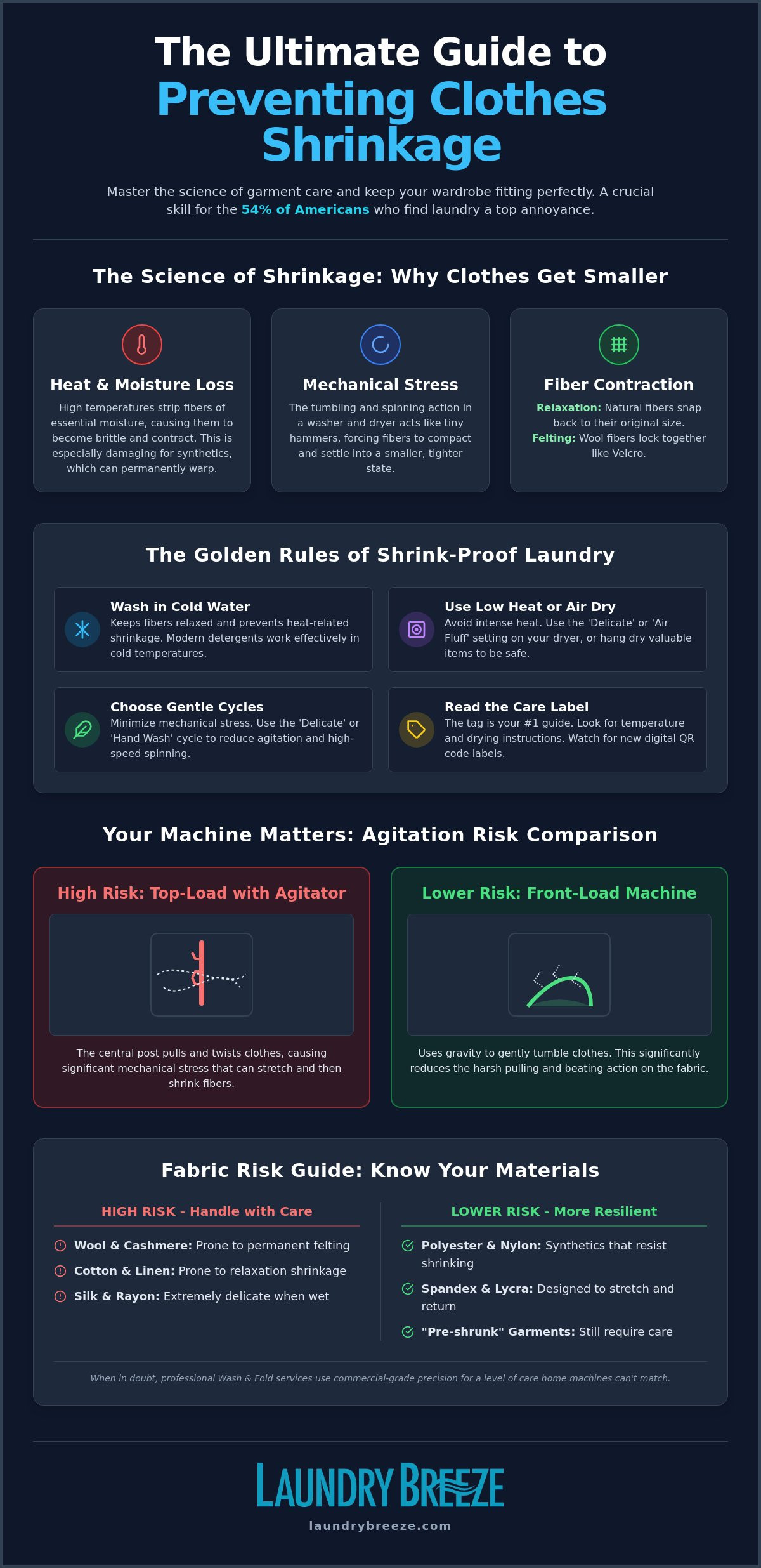
Shrinkage isn't a random laundry curse. It is a predictable physical reaction where textile fibers contract due to specific external stressors. Understanding The Science of Shrinkage is the first step in learning how to prevent clothes from shrinking. There are three primary ways this happens: relaxation, consolidation, and felting.
Relaxation shrinkage occurs mostly with natural fibers like cotton and linen. During the manufacturing process, these fibers are pulled and stretched tight to create fabric. When you drop them in water, they finally relax and snap back to their original, shorter size. Consolidation shrinkage is more aggressive. It happens when heat and mechanical agitation work together to "squish" fibers closer together. Finally, there is felting. This is unique to protein fibers like wool and cashmere. These fibers have microscopic scales that, when agitated in warm water, lock together like Velcro. Once they interlock, the garment is permanently smaller and often feels stiff.
The Role of Heat and Moisture
Heat is often the primary culprit people blame for a ruined wardrobe. High temperatures remove "structural moisture," which is the tiny amount of water fibers need to stay flexible and elongated. Without this moisture, fibers become brittle and tighten up. This is especially dangerous for synthetic materials like polyester or nylon. These fabrics have a "Glass Transition" point where the plastic fibers become malleable and prone to permanent warping or shrinking. Relaxation shrinkage is the process where tension from manufacturing is released during the first wash.
Mechanical Stress and Agitation
The physical environment inside your machine matters just as much as the temperature. Think of the tumbling action in a dryer as a thousand tiny hammers hitting softened fibers. This mechanical stress forces the fibers to settle into a more compact state. The type of machine you use changes the level of risk for your favorite outfits.
- Top-load agitators: These use a central post to pull clothes through the water, which can stretch and then snap fibers back into a shrunk state.
- Front-load machines: These use gravity to tumble clothes gently, reducing the physical "beating" the fabric takes during the wash.
- High-speed spin cycles: The centrifugal force of a fast spin can flatten fibers against the drum, causing them to lock into a smaller shape before they even hit the dryer.
The Golden Rules of Shrink-Proof Laundry
Every garment comes with a tiny, physical instruction manual. Following the care label is the single most effective way to understand how to prevent clothes from shrinking. Under the FTC Care Labeling Rule, manufacturers must provide these permanent tags, though the industry is actively reviewing a shift toward digital QR codes to provide even more care detail. Beyond reading the tag, you should follow these essential rules to keep your wardrobe in top shape:
- Wash in cold water: This keeps fibers in a relaxed state and prevents dye bleed.
- Turn clothes inside out: This reduces surface friction and mechanical wear on the outer fabric.
- Choose low heat: Use the lowest dryer setting or air dry your high-value items to avoid fiber damage.
- Use specialized detergents: Modern formulas work effectively without needing high temperatures.
Heat is your primary enemy. Air drying avoids the physical stress of the dryer on softened fibers, which is a key part of how to prevent clothes from shrinking over time. By reducing the temperature and the tumble, you extend the life of every thread.
Mastering the Temperature Dial
The "Warm" setting on most home machines is a gamble. It's often inconsistent and can reach temperatures high enough to trigger relaxation shrinkage in natural fibers. Modern 2026 cold-water detergents are formulated with specialized enzymes that break down proteins and oils without needing a single degree of heat. If you must use a dryer, know the difference between your settings. "Delicate" uses low heat, but "Air Fluff" uses no heat at all, simply tumbling the clothes to remove lint and soften the feel of the fabric.
The Los Angeles Hard Water Factor
Fabric-Specific Strategies: Cotton, Wool, and Synthetics
Every fabric in your closet has a unique "moisture memory." This is the internal physical state a fiber naturally wants to return to once it becomes wet. If you treat every garment the same, you're fighting against the very nature of the material. Mastering how to prevent clothes from shrinking requires a tailored approach that respects these different fiber personalities.
Cotton is the undisputed king of relaxation shrinkage. Even if your favorite shirt is labeled as "pre-shrunk," it can still shrink another 3% to 5% if it's mishandled. This happens because the tension applied during the weaving process is finally released when the fibers meet heat and water. Wool and silk are even more temperamental. These protein-based fibers require "zero-agitation" cleaning. Wool, in particular, has microscopic scales that lock together like Velcro when tossed around in a warm wash, leading to permanent felting.
Synthetics like polyester and spandex present a different challenge. They don't typically shrink in the traditional sense, but they are prone to "heat setting." If the dryer is too hot, these plastic-based fibers can warp or develop permanent wrinkles. Then there are the hidden monsters: rayon and viscose. These semi-synthetic materials are incredibly unstable when wet. They can lose significant size and shape in a single hot cycle, making them some of the most difficult items to manage at home.
Protecting Your Natural Fibers
Managing Modern Blends
Athleisure and performance wear require a specific touch to maintain their elasticity. Never use fabric softeners on moisture-wicking synthetics. These products leave a waxy coating that clogs the fibers, trapping odors and breaking down the spandex that gives your gear its stretch. To truly understand how to prevent clothes from shrinking or losing their "snap," wash these blends in cold water and skip the dryer entirely. Even a low-heat cycle can eventually degrade the elastic bonds, leaving your expensive gym gear baggy and worn out.
Laundry Myths: What Does Not Actually Work
Laundry "hacks" spread quickly on social media, but many of them do more harm than good. If you want to master how to prevent clothes from shrinking, you have to separate fact from fiction. One of the biggest misconceptions is that "pre-shrunk" labels are a guarantee of safety. In reality, these garments are just treated during manufacturing to reduce initial contraction. They can still lose significant size if you blast them with high heat or heavy agitation in your home machines.
Another common myth is that dryers are the only culprit. As we discussed in the science of shrinkage, relaxation happens the moment fibers hit water. If your wash cycle is too aggressive or the water temperature is too high, the damage is done before the clothes even reach the lint trap. Similarly, the idea that hot water is required for a truly hygienic clean is outdated. Modern 2026 detergents are designed with enzymes that are bio-active at temperatures as low as 60°F, providing a deep clean without the risk of fiber damage.
The Truth About "Unshrinking" Clothes
You've probably seen the "hair conditioner" trick online. People claim it can magically reverse a laundry disaster. While conditioner can temporarily lubricate fibers to make them easier to pull, you aren't actually unshrinking the garment. You are stretching it. This process often leaves the fabric misshapen and permanently weakens the structural integrity of the threads. Learning how to prevent clothes from shrinking is much more effective than trying to "relax" a ruined sweater. If you find yourself in a bind, you can check out our emergency guide on how to unshrink clothes for the safest methods to attempt a recovery. However, remember that prevention is always the better choice for your high-value wardrobe.
Debunking the Heat Necessity
High heat doesn't just shrink clothes; it also "sets" protein-based stains like blood, sweat, or grass. Once these stains are baked in by a hot wash or a high dryer setting, they become nearly impossible to remove. "Heat is the enemy of longevity; cold water is the fountain of youth for your wardrobe." By switching to cold cycles, you preserve the fit, the elasticity, and the color of your clothes for years instead of months.
The Ultimate Protection: Professional Wash & Fold
Are you tired of folding laundry and worrying if your favorite outfits will survive the next cycle? Even when you know the rules, home laundry remains a gamble. Professional services provide a level of precision that standard home machines simply cannot match. Commercial-grade equipment offers exact temperature control, which is the most reliable way to ensure your garments stay the correct size. Understanding how to prevent clothes from shrinking is much easier when you have expert technology on your side.
We believe laundry should be a breeze, not a source of anxiety. While home washers often have broad and inconsistent temperature ranges, our professional systems maintain steady environments for every load. We don't just sort by color. We sort by fiber weight and type to ensure that heavy denim never tumbles with delicate cotton. This customized care protects the structural integrity of every thread in your wardrobe.
Why Professional Cleaning Prevents Accidents
Reclaiming Your Time and Your Wardrobe
Master Your Wardrobe for Years to Come
You now have the tools to stop laundry accidents before they start. By understanding the science of fiber contraction and sticking to cold water cycles, you've mastered the most important steps for how to prevent clothes from shrinking. Remember that natural fibers like cotton and wool need a gentle touch, while modern synthetics require low heat to maintain their elasticity. You don't have to spend your entire weekend air-drying every item to keep your closet looking fresh.
As LA's top-rated "Fully Attended" laundromat, we are here to make your chores effortless. We offer FREE Pickup and Delivery in Beverly Hills, Santa Monica, and beyond. Our expert team follows our signature 4-minute laundry promise; it only takes 2 minutes to leave your bag out and 2 minutes to put your fresh clothes away. Why stress over complex laundry symbols when you can let our professionals provide top-quality care?
Take control of your laundry routine today and feel the difference of a professional touch. Your favorite outfits are in good hands!
Frequently Asked Questions
Can you unshrink clothes once they have gone through the dryer?
You cannot truly reverse the physical contraction of fibers, but you can sometimes stretch them back. Once heat and agitation lock fibers together, the damage is often permanent. While soaking in lukewarm water with hair conditioner can relax the fibers enough to pull them back into shape, the garment's structural integrity is lost. Prevention remains the best strategy for your wardrobe. It's much easier to avoid the dryer than to fix a ruined sweater.
What temperature is safest to prevent clothes from shrinking?
Cold water, typically around 60°F, is the safest temperature for almost every fabric type. This low temperature prevents the relaxation shrinkage common in natural fibers and protects the structure of synthetics. Modern 2026 detergents are specifically formulated with enzymes that break down stains at these lower temperatures. This ensures your clothes stay clean without the risk of heat damage. It's a simple change that makes a huge difference in garment lifespan.
Does 100% cotton always shrink?
Yes, 100% cotton is highly prone to relaxation shrinkage because the fibers naturally want to return to their shorter state. Even pre-shrunk items can contract an additional 3% to 5% if they're exposed to high heat. To keep your favorite cotton shirts fitting perfectly, always wash them in cold water and avoid high-heat dryer settings. Learning how to prevent clothes from shrinking starts with respecting the natural tendencies of cotton fibers.
Is it better to air dry or use the low heat setting on a dryer?
Air drying is the superior option for garment longevity because it eliminates mechanical stress and heat entirely. However, if you're short on time, using a low-heat or delicate setting is a safer alternative than a standard cycle. Low heat reduces the risk of fiber contraction while still providing the convenience of a machine. Just remember that air drying is the only way to guarantee zero shrinkage. It's the ultimate protection for your favorite pieces.
How do I know if a fabric is prone to shrinking before I buy it?
Check the fiber content on the care label before you reach the checkout. Natural fibers like wool, linen, and cotton are the most likely to shrink. Also, look for semi-synthetics like rayon and viscose. These materials are notoriously unstable when wet. If the label says Dry Clean Only, it's a clear signal that the material cannot handle the agitation of a home machine. Being a smart shopper saves you from future laundry heartaches.
Does dry cleaning prevent shrinking better than washing at home?
Dry cleaning is significantly safer for delicate garments because it uses a chemical solvent instead of water. Water is the primary trigger for relaxation shrinkage in natural fibers like wool and silk. By avoiding water and high-heat tumbling, dry cleaning preserves the original fit and finish of your clothes. It's the best choice for high-end silks and tailored items. Our professional service ensures your luxury wardrobe stays in pristine condition without the guesswork.
Why did my clothes shrink even though I washed them in cold water?
Shrinkage can still occur in cold water due to the mechanical agitation and spin speed of your machine. Fast spin cycles can pull and stretch fibers, causing them to snap back into a tighter shape. Additionally, if you put those clothes in the dryer afterward, the heat likely caused the contraction. Mastering how to prevent clothes from shrinking requires managing both water temperature and physical stress. Don't forget that the dryer is often the final culprit.
Can hard water in Los Angeles cause my clothes to shrink?
Hard water doesn't cause shrinking directly, but the mineral buildup makes fibers brittle and more prone to snapping. In areas like Santa Monica and Beverly Hills, high calcium levels coat threads, making them less flexible. When these stiff fibers are agitated in the wash, they're more likely to settle into a compact, shrunk state. Using a water softener or laundry booster helps keep your wardrobe supple. It's an essential step for residents in Los Angeles.
To see links to services mentioned in this article, please click
https://www.laundrybreeze.com


