

What if choosing a gentler detergent starts with the rinse cycle, not the front of the bottle? Labels such as “hypoallergenic” can sound reassuring, but the term has no U.S. federal definition, and “unscented” doesn’t always mean fragrance-free. If you’re sorting through claims and trying to identify what may bother your skin, this Guide for Best Detergents for Sensitive Skin offers a practical way to compare options without assuming one formula works for everyone.
Use the steps in this guide to test changes thoughtfully and notice how your own skin responds. If discomfort continues or you’re unsure what may be causing it, a qualified healthcare professional can help you decide what to do next.
Key Takeaways
- Compare ingredient information with your own product history instead of relying on broad marketing claims.
- Weigh liquid, powder, pods, and sheets by dosing control, convenience, storage, and label transparency. No format is automatically the best fit for everyone.
- Follow garment and detergent directions, measure carefully, and review your wash and rinse habits if you suspect laundry residue may be a factor.
- Change your routine thoughtfully and observe your personal response instead of switching several things at once.
- Before using a laundry service in Los Angeles, ask about detergent options and handling, and confirm whether your request can be accommodated.
What Makes a Laundry Detergent a Better Fit for Sensitive Skin?
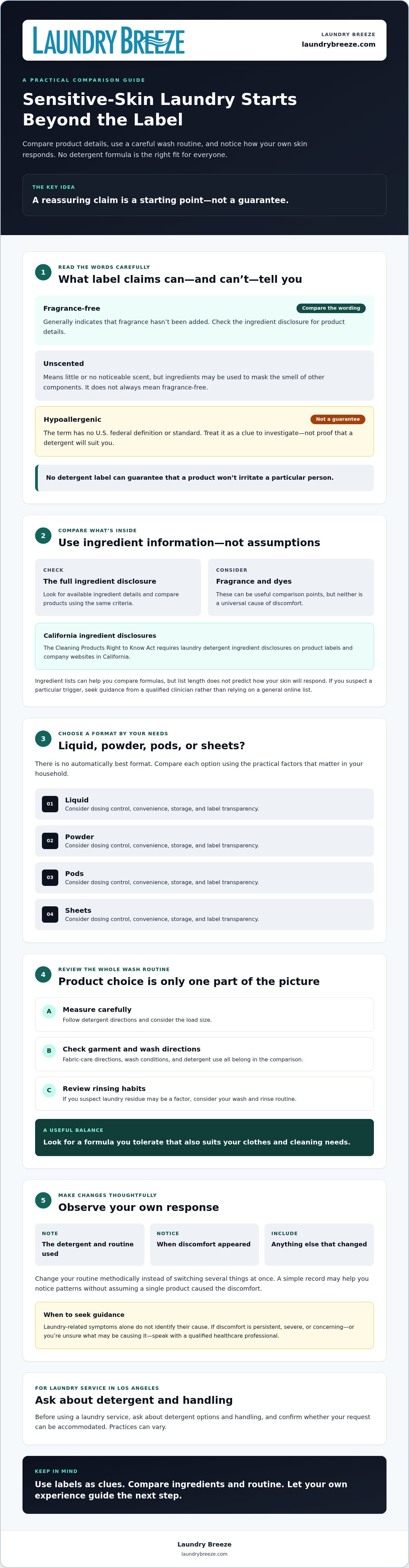
A detergent marketed for sensitive skin is a product category, not a promise that it will feel comfortable for everyone. These formulas may be designed to avoid certain features, such as added fragrance or dyes, but the label alone can’t predict your individual response. No detergent label can guarantee that a product won’t irritate a particular person.
It also helps to separate skin comfort from other laundry priorities. A product may suit your scent preferences but not clean the types of stains you commonly wash. Or it may clean well while requiring close attention to fabric-care directions. Aim for a practical balance: a formula you tolerate that suits your clothes and laundry needs.
Sensitive skin, irritation, and allergy are not interchangeable
“Sensitive skin” is a broad way to describe skin that reacts or feels uncomfortable under certain conditions. Irritation can occur without an allergy, while an allergic reaction involves the immune system responding to a particular substance. Contact dermatitis is a general term for skin inflammation after contact with an irritant or allergen, but a laundry-related symptom alone doesn’t identify its cause.
Skin discomfort can have causes beyond laundry products, and this guide can’t diagnose a condition. If symptoms are persistent, severe, or concerning, speak with a qualified healthcare professional.
Why a detergent that works for one household may not work for another
People have different sensitivities, clothing needs, and laundry habits. The detergent, amount used, wash and rinse routine, and contact with other products may all be worth considering. An ingredient that bothers one person won’t necessarily affect another, and no ingredient change is a universal fix.
Make changes methodically. Keep a simple note of the detergent and routine you used, when discomfort appeared, and whether anything else changed. This can help you spot patterns without assuming that one product is responsible.
That’s the approach behind this Guide for Best Detergents for Sensitive Skin: use labels as starting points, then consider your own experience. Cleaning performance and fabric-care directions still matter, so compare those needs alongside skin comfort rather than treating “sensitive skin” wording as a complete answer.
How to Read Sensitive-Skin Detergent Labels Without Guessing
Start with the exact wording, then look for details that help you compare products. “Sensitive skin” on the front label may point you toward a formula designed with skin comfort in mind, but it doesn’t confirm how your skin will respond. Ingredient information and your own experience are more useful than a reassuring phrase alone.
What fragrance-free, unscented, and hypoallergenic can tell you
Fragrance-free generally indicates that fragrance hasn’t been added. Unscented means a product has little or no noticeable scent, but it may use ingredients to mask the smell of other components. Wording and product details can vary, so check the ingredient disclosure rather than treating these terms as interchangeable.
Hypoallergenic is not a guarantee. The FDA says there’s no federal standard defining the term for products, so it may not tell you exactly how a formula was evaluated. Treat it, along with “sensitive skin,” as a clue to investigate, not proof that a detergent will suit you.
Which detergent ingredients should you compare?
Read the full ingredient disclosure when one is available. Fragrance and dyes are useful comparison points if you’re trying to understand what’s in a product, but neither should be treated as a universal cause of discomfort. Other ingredients may matter to an individual, too. If you suspect a particular trigger, ask a qualified clinician for guidance instead of ruling out ingredients based on a general list online.
Ingredient transparency can vary by location. In California, the Cleaning Products Right to Know Act requires laundry detergent ingredient disclosures on product labels and company websites. Use those details to compare formulas, not to assume that a longer or shorter list predicts how your skin will respond.
Keep this quick checklist handy in a store or while shopping online:
- Check whether the label says fragrance-free or unscented, and read the details.
- Look for a full ingredient disclosure, including online if needed.
- Compare fragrance and dyes based on your own product history.
- Treat “hypoallergenic” and “sensitive skin” as starting points, not guarantees.
- Change one product at a time so you can better track your response.
Liquid, Powder, Pods, or Sheets: Which Detergent Format Fits Your Needs?
Choose a detergent format based on how you prefer to measure, store, and use it, not because one type is automatically gentler. Skin comfort depends on the formula and your personal response, while format mostly affects convenience and dosing. A pod and a liquid can have different ingredient lists, so compare the product itself rather than assuming its format tells you what’s inside.
When dosing control and convenience matter
Liquids and powders usually let you measure the amount you use, which can help you follow load-specific directions closely. Pods and sheets offer pre-portioned convenience but give you less flexibility to adjust an individual dose. For any format, follow the package instructions, check that it’s suitable for your washer, and store it as directed and out of children’s reach.
| Format | Practical considerations | What to check separately |
|---|---|---|
| Liquid | Measured from the container; consider pouring and storage. | Ingredient list, scent claims, and recommended dose. |
| Powder | Measured from the package; consider where it can be kept dry. | Ingredient list, scent claims, and washer directions. |
| Pods | Pre-portioned for convenience, with less dose flexibility. | Ingredients and directions for your machine and wash. |
| Sheets | Lightweight and pre-portioned; follow instructions for use. | Ingredients, scent claims, and directions for your machine. |
How to compare a shortlist fairly
Use the same checks for each option. That keeps bright packaging or a familiar format from making the decision for you. The format affects how you handle and dose detergent; it doesn’t establish whether the formula is a good match for your skin.
- Formula: Compare fragrance wording and ingredient disclosures.
- Dosing: Check whether the amount can be measured for your load.
- Machine fit: Read the detergent and washer directions.
- Storage: Consider whether the container or packaging works for your home.
- Personal response: Keep notes if you try a new option, and avoid changing several products at once.
A fair comparison doesn’t require ranking formats from best to worst. Choose a product whose directions fit your laundry routine and whose disclosed ingredients you can assess. The Guide for Best Detergents for Sensitive Skin is a decision framework, not a universal verdict: shortlist by label and practicality, then pay attention to your own experience.
A Sensitive-Skin Laundry Routine: Dosing, Rinsing, and Troubleshooting
A steady routine makes it easier to notice what may be affecting your laundry without changing several things at once. Follow garment and detergent directions, measure an appropriate dose, and review the result before making another adjustment. Extra detergent isn’t automatically extra cleaning: Follow the product directions, because using more detergent than directed may leave unwanted residue rather than make clothes cleaner.
How much detergent should you use?
There isn’t one dose that fits every load. Check the detergent package for guidance based on load size and soil level, then follow your washer’s instructions for detergent use. Don’t estimate by habit if the product provides a measuring guide. If you use a pre-portioned format, follow its directions rather than adding another portion simply because the load looks large.
Use this simple routine:
- 1. Read the directions. Check garment care labels, detergent instructions, and relevant washer guidance before washing.
- 2. Measure carefully. Use the amount indicated for your load and its soil level. Avoid adding extra as a precaution.
- 3. Wash as directed. Use a cycle and settings that are compatible with the garments, detergent, and machine.
- 4. Review the result. Notice whether clothes seem clean and whether discomfort or other concerns persist. Record the product and routine so you can compare later.
What should you change if discomfort continues?
Look back at recent changes: a new detergent, a different dose, a fragrance product, or a change to your usual rinse routine. Check the detergent directions for rinse guidance, and consult your washer manual before changing machine settings. If you test an adjustment, change one variable at a time. That makes it easier to distinguish a pattern from coincidence.
Repeatedly switching products can make it harder to identify a pattern, and laundry adjustments can’t determine the medical cause of skin symptoms. If symptoms are ongoing, severe, or concerning, seek advice from a qualified healthcare professional rather than relying on more detergent experiments.
Choosing a Sensitive-Skin Laundry Approach in Los Angeles
A practical choice starts with three things: the label, your own product history, and what you observe after washing. A detergent that avoids a scent or ingredient you’re trying to limit may be worth considering, but it can’t promise a particular skin response. Follow product directions, make changes thoughtfully, and seek professional advice for persistent or concerning symptoms.
Using a laundry service adds another consideration: find out how detergent choices and special instructions are handled before you book. Don’t assume a service uses a fragrance-free formula or can accommodate a specific product. Ask first, then decide whether the available options fit your needs.
Questions to ask before using a laundry service
Keep your questions specific. Ask which detergent options are available and whether you can request a fragrance-free product. Then ask how special instructions are recorded and confirmed, so you know whether your request can be accommodated. Practices vary by provider, and a label you prefer won’t help if you don’t know what will be used.
Before booking with Laundry Breeze, contact the team to ask about detergent options and handling. Confirm that your preferences can be accommodated rather than making assumptions.
When local laundry help may make the routine easier
Pickup and delivery can be a convenient alternative when doing laundry at home isn’t practical, but it isn’t a treatment for skin concerns. Laundry Breeze offers free pickup and delivery for laundry in Los Angeles and nearby areas. Ask about detergent options and how instructions are handled before arranging service.
This Guide for Best Detergents for Sensitive Skin is meant to help you make an informed choice, not diagnose symptoms or promise a result. Compare what’s disclosed, consider what has or hasn’t worked for you, and choose the laundry approach that fits your preferences. Laundry Breeze serves customers in Los Angeles, Beverly Hills, West Hollywood, Culver City, Santa Monica, Venice, and Westwood. Contact the team to ask about detergent handling and service options in your area.
Choose a Laundry Routine That Works for You
The Guide for Best Detergents for Sensitive Skin comes down to a few practical steps: compare ingredient disclosures instead of relying on label claims, choose a format that fits your routine, and follow the product’s dosing and rinsing directions. Your personal history and observed response matter more than a one-size-fits-all promise. If discomfort persists or concerns you, seek advice from a qualified healthcare professional.
Small, thoughtful adjustments can make laundry choices feel more manageable. Keep track of what works for you, and take the next step with confidence.
Frequently Asked Questions
What is the best laundry detergent for sensitive skin?
The best option is one whose label fits your preferences and whose use suits your personal experience. Compare ingredient disclosures, fragrance wording, and directions instead of choosing by a “sensitive skin” claim alone. No formula works the same way for everyone. The Guide for Best Detergents for Sensitive Skin can help you narrow your choices, then track how your laundry routine and skin respond.
Is fragrance-free detergent better for sensitive skin?
Fragrance-free detergent can be a useful option to compare, especially if you’re trying to avoid added fragrance, but it isn’t a guarantee of comfort. Check the ingredient disclosure and product details, since labels and formulas can vary. Your own history matters, too. If you’ve noticed a pattern with scented laundry products, consider comparing fragrance-free options while changing one product at a time.
Can hypoallergenic laundry detergent still cause irritation?
Yes. “Hypoallergenic” doesn’t guarantee that a product won’t bother a particular person. The term has no U.S. federal definition for products, so it doesn’t provide a standardized assurance of personal compatibility. People can respond differently to the same formula, and skin symptoms may have causes beyond detergent. Treat the claim as a prompt to inspect the label, not as a promise or diagnosis.
How do I know if my laundry detergent is irritating my skin?
You can look for patterns, but you can’t confirm the cause from timing alone. Note when discomfort occurs and whether you recently changed detergent, dose, fragrance products, or laundry habits. Adjust one factor at a time and record what happens, rather than switching several products at once. Skin symptoms can have other causes. Ask a qualified healthcare professional about persistent, severe, or concerning symptoms.
Should I use less detergent if I have sensitive skin?
Use the amount directed on the detergent package rather than automatically reducing or increasing the dose. The guidance may account for load size or soil level, and washer directions can also matter. Using more than directed may leave unwanted residue, but there isn’t one reduced dose that suits every product, load, or machine. Measure as instructed and review the result before making a routine change.
Does an extra rinse help with detergent residue?
An extra rinse may help in some situations, but it isn’t a universal fix. Results depend on the garment, washer, detergent, and the directions for each. Check the garment care label and machine guidance before changing rinse settings. If you suspect residue, first review whether you measured detergent as directed and loaded the washer appropriately. If discomfort continues, consider other causes and seek professional advice.
Can I bring my own detergent to a Los Angeles laundry service?
Ask the laundry service before bringing your own detergent. Policies and available options vary, so check whether fragrance-free options are available and how special instructions are handled before booking. Laundry Breeze serves Los Angeles and nearby communities, including Beverly Hills, West Hollywood, Culver City, Santa Monica, Venice, and Westwood. Confirm current coverage and detergent arrangements directly.
To see links to services mentioned in this article, please click
https://www.laundrybreeze.com


