

When laundry piles up, it can take time away from serving guests, members, and customers. You want clean, ready-to-use items without adding another chore to the workday. This guide explains how customized laundry service can support businesses, hotels, and fitness centers, what per-pound pricing means, and which details shape a quote. You’ll also learn what to consider when deciding whether an outside laundry service is a practical fit for your routine.
Key Takeaways
- Match laundry handling to your business’s recurring items, such as towels, linens, or uniforms, and the routine that suits your operation.
- Understand how a customized quote can reflect the type and volume of laundry your business needs handled.
- Per-pound pricing bases the charge on laundry weight, so the load is central to understanding the service cost.
- Hotels and fitness centers can plan laundry around the different items their guests and members use.
- Explore a commercial laundry option when cleaning recurring business laundry is taking time away from your day-to-day work.
Customized commercial laundry for businesses
Choose a provider by matching its laundry handling to your items and routine. Pickup, delivery, turnaround, and minimum volume depend on service terms and your laundry pattern.
Business Types Served
Los Angeles businesses have different laundry needs. A hotel may need regular linen processing, while a fitness center goes through towels and uniforms. A salon or restaurant has its own mix of frequently used items. Start with the textiles your business actually uses, then note how often they need cleaning and when clean items must be ready. This keeps the service plan practical rather than treating every load alike.
Minimum-Volume Requirements
Before setting up service, estimate your typical laundry volume and how it changes during busy and quieter periods. A small salon’s towel loads differ from a hotel’s recurring linens, so describe your usual mix and frequency. A clear picture of regular operations helps you choose a service plan that fits your needs, not just a peak-period workload.
How do you choose a commercial laundry service for a business? Match the service to your textiles, schedule, and recurring laundry needs. A fitness center, for example, can plan around towel loads, while a hotel can focus on linens and uniforms. Also consider how laundry will be handed off and how clean items will return to your operation.
Pickup and delivery should fit the hours when your business can prepare laundry and receive clean items. Turnaround affects how much inventory you need between loads, so account for it when planning. For example, consider how laundry movement fits around hotel room turnover or a gym’s busy periods. Timing works best as part of the operating plan, not an afterthought.
Business hours shape that schedule. List the times your staff can hand off laundry and the periods when clean items are most needed. A restaurant, for example, may plan around its opening and closing routines, while a salon may coordinate with appointment flow. Keep the schedule tied to actual work patterns, so laundry handling doesn’t interrupt customer service or leave essential textiles unavailable.
Before setting up a routine, group items by use and identify what needs regular cleaning. Separate towels, linens, and uniforms, then note when each group is needed again. This simple inventory helps clarify the workload and lets your business plan storage and backup items. It can also reveal when seasonal demand changes your usual laundry pattern.
Commercial rates and customized quotes
A business quote turns a laundry routine into a clearer cost plan. The amount depends on the case and is given after a quote request; factors include item types, laundry volume, service frequency, and pickup and delivery needs.
Pickup and delivery can be priced within a service arrangement or shown separately. The quote should make clear whether collection, return, and processing are bundled or itemized, so you can understand what each charge covers.
Prepare useful details before arranging service. A hotel can describe its recurring sheets, towels, and uniforms, while a fitness center can outline its towel loads. These specifics show what needs cleaning and how the service must fit daily operations.
Ask for a quote that describes the planned service in plain terms. A clear breakdown can show how the business’s laundry mix, expected load, and pickup routine shape the proposed arrangement. If your needs change, such as adding a new item type, the original assumptions may no longer match the work.
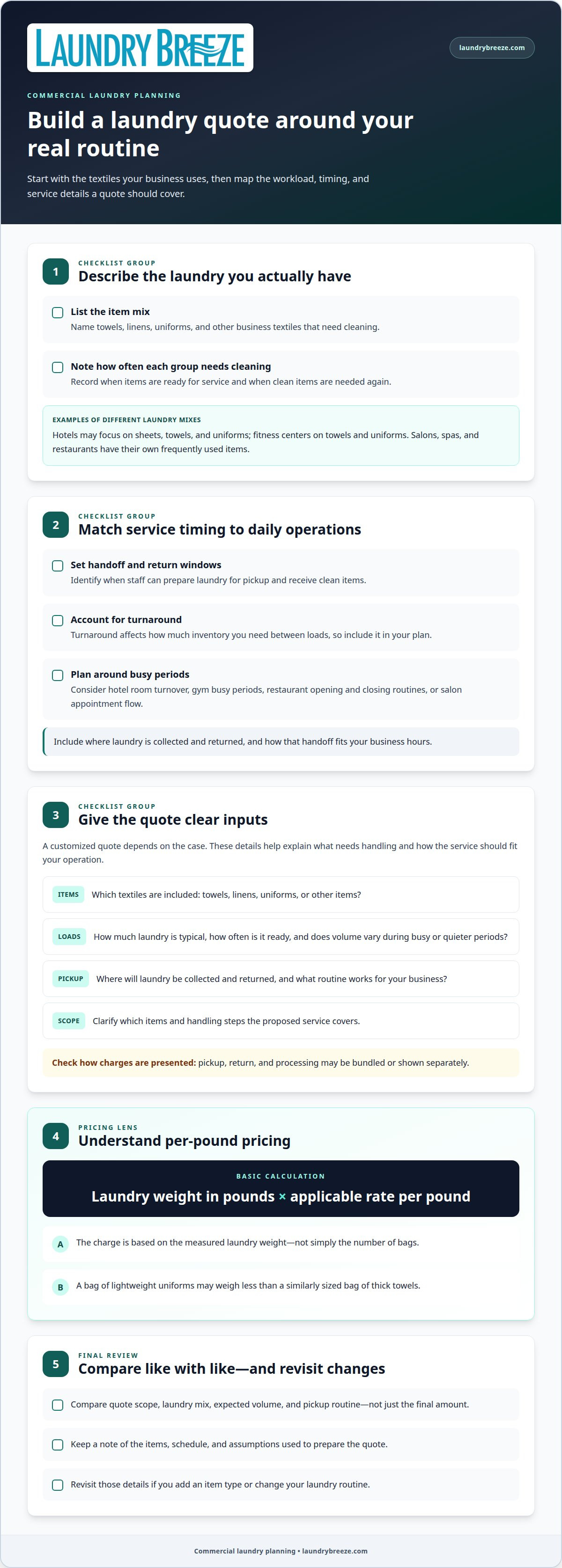
- Item mix: Identify towels, linens, uniforms, or other business textiles.
- Load pattern: Describe how often laundry is ready and whether volume varies.
- Pickup details: Explain where laundry is collected and returned.
- Service scope: Clarify which items and handling steps the quote covers.
These details help distinguish a useful estimate from a vague total. For instance, a spa handling mostly towels has a different laundry mix from a restaurant processing table linens and uniforms. Naming the items also helps prevent misunderstandings about what the requested service includes.
Compare quote descriptions by scope, not just by the final amount. One proposal might include pickup and return, while another may list those parts separately. A careful comparison checks whether both quotes describe the same items, expected volume, and collection routine. Otherwise, two totals may represent different services.
A customized quote also gives your business a planning reference. Keep a note of the items, schedule, and assumptions used to prepare it. If a hotel adds a new linen type or a gym changes its towel routine, those details can help update the request accurately.
Per-pound service pricing
Per-pound pricing calculates laundry charges from the weight of the items processed. The basic calculation is the laundry weight in pounds multiplied by the applicable rate per pound. A business can use this method to relate its laundry volume to its service cost without assuming every load weighs the same. A commercial laundry service that bills by weight bases the calculation on the measured laundry, not simply the number of bags.
For example, a bag of lightweight uniforms may weigh less than a similarly sized bag of thick towels. Under per-pound pricing, the measured weight, rather than the number of bags, determines the charge. That makes the amount of laundry an important part of understanding the cost.
Ask how the service determines the weight used for billing. A clear explanation should identify whether the charge applies to the full load or to defined categories. For instance, a hotel handling sheets, bath towels, and staff uniforms can ask how those different items appear in the weight calculation.
Keep a simple record of your own loads to understand how volume changes. A fitness center might note that towel laundry grows during busy periods, while uniform loads stay more consistent. These records help explain the business’s routine when requesting a quote and make it easier to compare a typical load with a higher-volume one.
- Identify the items: List towels, linens, uniforms, or other textiles in each load.
- Estimate the pattern: Describe whether loads stay steady or change with business activity.
- Clarify billing weight: Ask what weight measurement the per-pound calculation uses.
- Review included work: Check whether the quoted scope includes collection and return.
Per-pound pricing does not, on its own, describe every detail of a laundry service. Be clear about the service and items you need processed. A restaurant with table linens and uniforms, for example, should name both categories rather than describing everything simply as “laundry.”
Use the same assumptions when comparing quotes. If one estimate reflects towels and uniforms, while another assumes towels alone, the totals don’t describe identical loads. Align the item mix, estimated weight, and service details first. Then the per-pound basis becomes easier to understand without relying on an unsupported industry average.
Tracking weight can help a business understand changes in laundry demand. If a salon’s towel loads become heavier after adding services, its recorded laundry volume can help explain changes in its laundry charges. Keeping notes on representative loads makes it easier to plan routine costs.
Keep your laundry notes together and update them when your inventory or routine changes. A new linen type or a seasonal increase in towels can affect the weight pattern. Current details help Laundry Breeze plan its commercial laundry service around the work your business needs handled.
Commercial laundry for hotels and fitness centers
Hotels and fitness centers rely on different textiles, so their laundry routines have different priorities. A hotel may process sheets, pillowcases, bath towels, and staff uniforms. A gym may focus on workout towels and team uniforms. Grouping items by use helps each business describe its needs and identify which textiles must be ready first.
For a hotel, linen availability connects directly to room turnover. Housekeeping may need fresh sheets and towels while used items accumulate from guest rooms. Separate those categories in your laundry plan, then note where clean items should return and how staff will store them. Identify comforters and pillows separately from everyday sheets and towels.
Fitness centers have a different rhythm. Workout towels move from member areas to laundry throughout the day, while staff uniforms follow another routine. Identify where used towels are collected and where clean ones are restocked. This gives the service a practical picture of the flow, from towel bins to the laundry handoff and back to the gym.
Item tracking helps prevent confusion. A hotel can label bags by floor or linen category; a gym can keep towels separate from uniforms. Use consistent, simple labels so staff can identify each bag and clarify which textiles belong in each load.
- Hotel linens: List sheets, pillowcases, towels, and other recurring room textiles.
- Gym towels: Identify the towel types used in workout or changing areas.
- Uniforms: Keep staff clothing distinct from guest or member textiles.
- Special items: Note comforters and pillows separately from routine loads.
Schedule laundry around how your business uses its inventory. A hotel can relate linen needs to room turnover, while a fitness center can plan towel restocking around member activity. Describe the busiest periods and the items that run short first. That context helps shape a service plan around real operations, rather than treating every textile as equally urgent.
Staff communication matters, too. A hotel housekeeping team and a gym’s front-desk staff may handle different stages of collection and restocking. Decide who prepares laundry, where it goes, and who receives clean items. Clear responsibilities help prevent misplaced bags and get clean textiles to the right department.
Laundry Breeze provides Commercial Laundry Service for businesses, including hotels and motels. Start by listing the textiles in circulation, such as sheets, towels, and uniforms, and the teams responsible for them. This connects laundry processing with the daily work of guest rooms and fitness spaces.
Commercial laundry services
Outsourcing means sending laundry elsewhere for processing instead of managing it onsite. A commercial laundry service handles the washing work, while your business plans the handoff and clean-item storage. With in-house equipment, employees manage each step themselves. The practical choice depends on space, staff time, equipment needs, and how laundry fits into daily operations.
For example, a Los Angeles salon can weigh its recurring towel loads against the time staff spend sorting, washing, and folding them. In-house laundry keeps those tasks onsite but requires equipment and space. Outsourcing moves processing offsite. Consider the whole routine, including loading machines and keeping clean towels ready, rather than comparing equipment costs alone.
Laundry handling needs depend on the items and the business setting. Hotel linens, restaurant textiles, and medical-facility laundry may have different requirements. Describe the items your business needs processed and how they are used. Laundry Breeze keeps each client’s laundry separate and never mixes it with another client’s items.
Certifications also need context. A credential applies to the scope it covers, not automatically to every textile or business setting. Avoid treating one certification as proof of every hygiene practice. For a specific facility, identify the relevant expectations first, then assess whether the stated laundry procedures address those needs.
Keep clear item descriptions and load records for laundry sent out. For instance, note a distinctive uniform or a tablecloth with a pre-existing stain before sending it. For garments and specialty uniforms that require professional dry cleaning and pressing, services such as The Laundry Hub illustrate how specialized care can be integrated into regular textile management. If an item returns missing or damaged, record its description and the load details promptly. This gives your business a clear basis for discussing the issue.
Laundry Breeze provides commercial laundry and pickup and delivery in Los Angeles and nearby areas, including Beverly Hills, West Hollywood, Culver City, Santa Monica, Venice, and Westwood. Businesses in these locations can plan collection and return around their regular operations.
Before choosing an outside service, write down the items, handoff location, and clean-laundry destination. A hotel might note which department receives its linens; a gym can specify where fresh towels should go. A commercial laundry service can use these operational details to understand the requested work and how it fits the business.
Laundry Breeze: Commercial Laundry Service
Laundry Breeze’s Commercial Laundry Service handles business items such as towels, linens, and uniforms, helping reduce the laundry work on your team’s schedule. It can suit businesses with recurring loads that want processing handled outside their daily operations.
With a commercial laundry service, pickup and delivery can make the handoff more convenient. Hotels and other businesses with bulky bedding can also use Comforter & Pillow Laundry Service. Share the items your business needs cleaned to identify a suitable service for its routine.
If you’re considering a commercial laundry service for your business, contact Laundry Breeze to discuss your laundry needs.
Make your next laundry decision simpler
A useful next step is to connect your laundry routine with the service that fits it. Consider which items take the most staff time, where they need to be collected, and how clean laundry should return to your operation. Share those details with Laundry Breeze to discuss commercial laundry service for your business.
Laundry Breeze offers Commercial Laundry Service for recurring business items, Pickup & Delivery Laundry Service for a convenient handoff, and Comforter & Pillow Laundry Service for bulky bedding. Choose the service that matches the work you want to take off your team’s hands. A clear description of your items and routine makes the conversation more useful.
Frequently Asked Questions
What services do commercial laundry companies provide?
Commercial laundry services process business textiles such as towels, linens, and uniforms. Laundry Breeze serves businesses including hotels, gyms, salons, medical spas, and restaurants, with commercial laundry and pickup and delivery. Group items by type to describe your needs and plan how clean laundry should return to your operation.
How much does commercial laundry service cost per pound or load in the U.S.?
There is no single U.S. rate for every business laundry load. Per-pound billing calculates charges from the weight processed, while per-load billing uses the agreed load as its basis. The final cost depends on factors such as the items, volume, service frequency, and whether pickup and delivery are included. Compare estimates only when they describe the same laundry and service scope.
Which industries use commercial laundry services?
Hotels, gyms, salons, medical spas, restaurants, and short-term rental businesses use laundry services for recurring textiles. A hotel may need guest linens, while a restaurant handles table linens and uniforms. In Los Angeles, Beverly Hills, West Hollywood, Culver City, Santa Monica, Venice, and Westwood, businesses can consider their laundry mix and choose a service suited to those items and their operating routine.
What pickup, delivery, turnaround, and minimum-volume requirements do providers have?
Pickup, delivery, turnaround, and minimum volume depend on the provider’s service terms and your laundry pattern. Choose pickup and delivery times that fit your business hours, check that turnaround leaves enough clean inventory, and confirm the minimum volume fits your regular loads.
To see links to services mentioned in this article, please click
https://www.laundrybreeze.com


