

The best laundromat for your needs is one with clear pricing, hours that fit your schedule, the right washer and dryer options, and amenities and payment methods you’ll actually use. Some laundromats charge for wash-and-fold by the pound, weighing dry laundry before washing. Many U.S. laundromats operate 24 hours a day, but opening hours and last-wash times vary by location.
Laundry day is easier when you know what to expect before you arrive. This guide explains how to compare Laundromat options in Los Angeles, check hours and last-wash cutoffs, and weigh machine availability, payment methods, and amenities. You’ll also find practical ways to choose a setup that suits your load and routine, so you can spend less time guessing and more time getting on with your day.
Key Takeaways
- Compare pricing methods and promotion terms so you can estimate the total for your laundry needs.
- Plan around a location’s opening hours and last-wash cutoff to avoid arriving too late to start a load.
- Use customer reviews to assess cleanliness, service, and amenities that matter during your visit.
- Look at payment methods and machine sizes before choosing a location, especially for larger loads.
- If you’d rather skip the trip, Laundry Breeze offers pickup and delivery, wash and fold, and comforter and pillow laundry services.
Laundry service prices and promotion
Compare the service and its pricing method before choosing a laundry option in Los Angeles. Self-service costs depend on the machines and cycles you use. Drop-off service may be priced by laundry weight or by individual garment. Laundry Breeze offers self-service, wash-and-fold, dry cleaning, and bedding cleaning, each with its own pricing structure.
For an accurate comparison, separate machine use from staff-handled service. With self-service washers and dryers, you choose the machines and manage each stage. With drop-off wash-and-fold, staff wash, dry, and fold your clothes. For a service order, the total depends on load weight, garment care, and selected add-ons; service pricing is set after a quote request.
Check what a laundry offer includes before choosing a service. Compare the price and work covered, such as washing, drying, and folding, with any separate garment-care or bedding service you need. Laundry Breeze lists prices for its services and individual bedding items, so you can compare the applicable charge rather than relying on a general estimate.
Laundry services can include self-service washers and dryers, drop-off wash-and-fold, and specialized garment care. With wash-and-fold, you leave clothes for staff to wash, dry, and fold. A self-service visit means you run the wash and drying cycles yourself, then take your clean clothes with you. These are different ways to handle the same basic chore.
For self-service, choose a washer suited to the load, then move your clothes to a dryer after washing. You manage the cycles and stay responsible for each stage. For wash-and-fold, hand over the laundry and collect it after staff finish the service. The first option gives you control; the second removes washing and folding from your task list.
Follow simple shared-space etiquette: sort clothes before loading, use only the machines you need, and move finished laundry promptly. Don’t leave a completed load in a washer while you run errands. Keep your basket and supplies out of walkways, and leave the machine area tidy for the next person.
Bring your laundry, a basket or bag, and payment suited to the machines. Add detergent if you plan to wash clothes yourself; a stain-treatment product can help with a marked shirt. For drop-off service, separate garments needing special care and explain the request when handing them over.
Use this sequence for a self-service visit:
- Sort clothes by color, fabric, and care needs.
- Choose a washer that fits the load and read its instructions.
- Add detergent, start the wash, then transfer clothes to a dryer.
- Collect the clean laundry and check the machine before leaving.
Store hours and last wash time
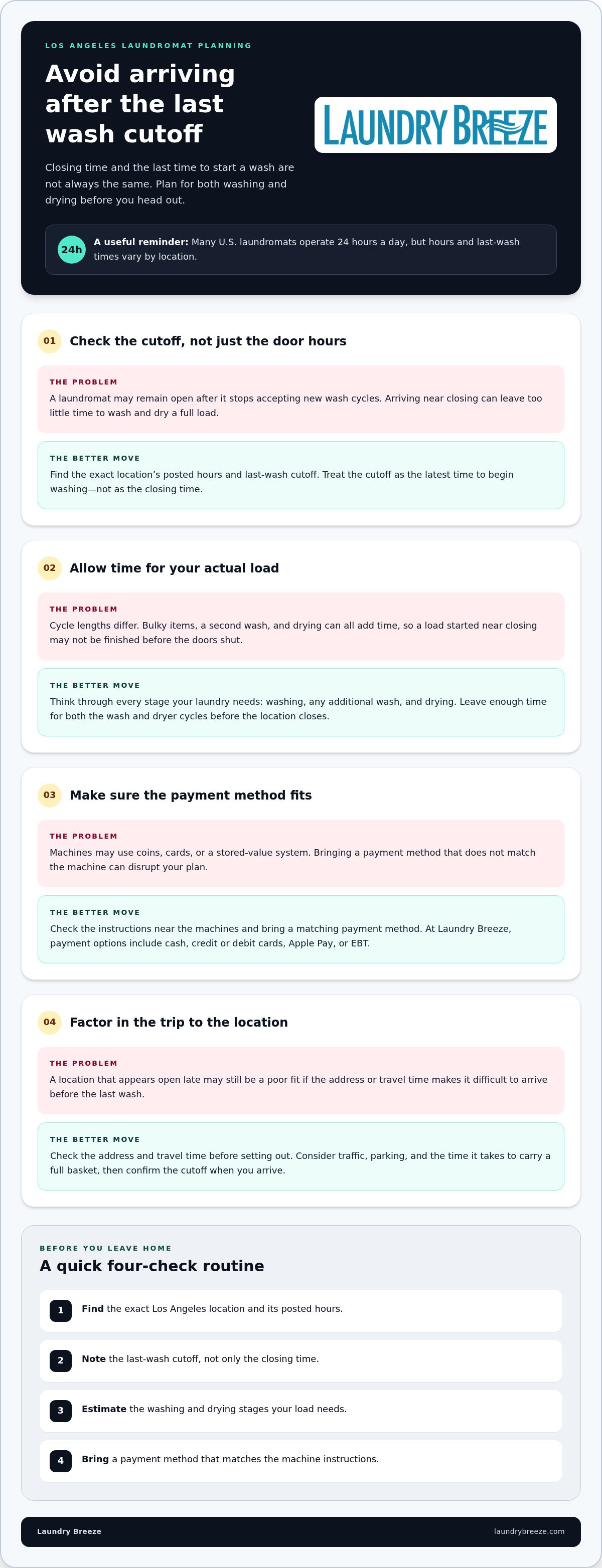
Many U.S. laundromats operate 24 hours a day, but hours vary by location. In Los Angeles, separate the posted opening hours from the last time you can begin a wash. A door may remain open while new wash cycles are no longer available. The distinction matters if you’re planning laundry after work or before an early appointment.
Last wash time is a practical cutoff, not necessarily closing time. A posted cutoff gives customers time to finish washing and drying before the business closes. Arriving shortly before closing may leave too little time for a full load and dryer cycle. Check the posted cutoff, then allow time for both stages.
Plan around the work your clothes need. A small load may finish sooner than a bulky one, while a second wash adds another cycle. Drying also takes time, depending on the items and settings. Cycle lengths differ, so don’t assume a load started near closing will be ready before the doors shut.
Payment methods can affect your arrival plan, too. Laundromat machines may accept coins, cards, or a stored-value system. At Laundry Breeze, customers can pay with cash, credit or debit cards, Apple Pay, or EBT. Read the instructions near the machines before starting, and check the display to confirm the selected cycle and charge.
Use this quick routine before leaving home:
- Find the exact Los Angeles location and its posted hours.
- Note the last wash cutoff, not only the closing time.
- Estimate the wash and drying stages for your load.
- Bring a payment method that matches the machine instructions.
Location matters as much as hours. A nearby Laundromat in Hollywood may fit an evening schedule better than one across Los Angeles, even if both appear open late. Check the address and travel time before setting out. Traffic, parking, and carrying a full basket can change how long the trip takes.
For a late visit, prioritize locations with clearly posted hours and last-wash guidance. If the details appear on a door sign, read them before unloading your basket. If the schedule is shown online, compare it with the location’s own posted information when you arrive. That simple step helps prevent starting a load too late.
Coin-operated laundry has a history of its own. Harry Greenwald created Greenwald Industries in 1957. A Philadelphia laundromat that opened in 1947 is believed to have been the first coin-operated laundromat in the United States.
Customer reviews and laundromat amenities
Use customer comments to assess day-to-day conditions, then compare amenities with your actual needs. A useful review describes a specific visit, such as clean folding tables or an untidy machine area.
Customer Feedback and Reliability
To find a nearby location that suits you, compare recent reviews and look for repeated details about cleanliness, working machines, and staff helpfulness. One comment may describe a single visit; several similar comments can reveal a more consistent pattern.
Read for concrete examples, not just star ratings. A review mentioning lint around dryers, full trash bins, or dirty folding tables tells you what the customer saw. Positive details matter too, such as an orderly seating area or an attendant responding to a problem.
Check whether reviews describe conditions relevant to your visit. Comments about family seating can help parents assess the space, while notes about payment can clarify a practical convenience. Compare review dates and details, then decide which factors matter most for your routine.
Amenities, Safety, and Hygiene
Look for a family area where children can sit while an adult stays nearby. Check whether the seating is visible from the machines you plan to use. Laundry Breeze’s attended laundromat has free Wi-Fi, television, and vending machines, along with staff on site.
For safety, notice the entrance, lighting, visibility across the room, and whether staff are present. Laundry Breeze’s laundromat is fully attended. Keep your belongings with you and stay near your laundry rather than leaving bags unattended. A clear view of the machines and exits makes it easier to keep track of your visit.
For hygiene, inspect the washer drum and door before loading clothes. If you see residue or debris, choose another machine. Keep detergent and baskets off shared folding surfaces, and wipe a surface before placing clean clothes there. Wash your hands after handling dirty laundry or shared machine controls.
Use this quick visit checklist:
- Check the washer drum and folding table before use.
- Choose seating where you can keep children in view.
- Keep your basket, phone, and other belongings nearby.
- Notice whether the room, entrances, and machine area feel orderly.
Amenity lists can sound similar, so judge each feature by how you’ll use it. For example, Wi-Fi may help during a long visit, while a family area can make waiting with children easier. Pair those practical details with review comments about cleanliness and service to choose a location that suits your needs.
Machine payment options
Payment systems vary between Los Angeles laundry locations and machines. Some accept coins, while others use cards, reloadable laundry cards, or mobile payment. A central kiosk may handle payment for several machines. Read the posted instructions before loading clothes, so you know which method works.
Coin-operated machines are straightforward when you have the right change. Look for the coin slot and cycle instructions before adding detergent. If a machine accepts only specific coins, you may need to use a bill changer or speak with an attendant. Don’t assume a nearby shop has change, especially during a late visit.
Card payment can mean tapping or inserting a bank card at the machine. Other locations may use a laundry card that you load at a kiosk. These systems work differently: one charges a payment card, while the other stores value for future cycles. Read the screen prompts and keep the card until the cycle starts.
Mobile payment may be available through a machine’s screen or payment system. Follow the displayed steps, select the machine, and confirm the cycle before leaving the kiosk. Don’t assume every washer and dryer uses the same process. For example, a washer might accept a laundry card while a nearby dryer requires a separate selection.
Before starting, check the machine display for the selected cycle and charge. Compare the setting you chose with the amount shown, then confirm payment. If the display doesn’t change after payment, pause before paying again. A second transaction could start another cycle rather than resolve the first attempt.
Use this short payment check at the machine:
- Find the payment instructions on the machine or kiosk.
- Confirm whether it accepts coins, a bank card, or stored value.
- Select the cycle and review the displayed charge.
- Complete payment and make sure the machine starts.
Keep a backup payment method if your preferred option might not work. For example, bring a bank card alongside coins when visiting an unfamiliar location. If you use a laundry card, store it safely between visits and note whether the kiosk allows balance checks. These steps help prevent a payment snag from interrupting your wash.
If a screen shows an error, record the machine number and exact message. Check the posted instructions for help, or speak with an attendant when one is present. Avoid repeatedly tapping a card or restarting the machine before understanding the prompt. A clear error message can help staff identify the issue.
Payment convenience is one part of choosing a Laundromat. Match the system to your routine: coins suit customers who carry change, while card or mobile options may reduce loose items. The clearest setup explains payment at the machine, shows the charge before confirmation, and makes the next step easy to follow.
Washer and dryer availability
Machine choice matters when your load includes bulky bedding or everyday clothes. Compare washer capacity, available machine types, and dryer access before starting. A drum that fits a small clothing load may not suit a comforter. Matching capacity to each item helps avoid crowding and extra cycles.
Read the capacity label on each washer, then consider what you’re washing. A basket of shirts needs different space than a comforter or several towels. Leave room for clothes to move through the wash. If the load looks tightly packed, choose a larger machine or use Laundry Breeze’s bedding cleaning service.
Check the dryer options, too. A washer may be open while the dryers are occupied, leaving wet laundry waiting. Look across the room before starting a wash, especially with a large load. A basket of towels, for example, may need more drying space than a few lightweight shirts.
Machine availability can change during your visit as customers finish cycles. Notice which washers are running and which are ready. If you’re washing separate loads, choose machines near each other when possible. That makes it easier to keep track of colors, fabrics, and the transfer from washer to dryer.
For bulky items, look for a washer with enough room for the fabric to move freely. A comforter compressed against the drum may not wash as intended. For mixed laundry, separate items by care needs and load size. Match each group to a suitable machine instead of forcing everything together.
Use this practical sequence to choose machines:
- Separate bulky items, towels, and everyday clothes.
- Read the capacity label on each available washer.
- Choose a drum with room for the load to move.
- Check dryer access before starting the wash.
Also consider the machine layout. Controls should be easy to read, and the route between washers and dryers should let you carry a basket comfortably. If a machine is marked out of service, select another before loading. A quick look at labels, controls, and the path between machines can make the visit smoother.
For oversized bedding, don’t judge capacity by appearance alone. Compare the item with the machine label and leave enough room for movement. When several loads need washing, start with the items that require the largest washer. For comforters and pillows, Laundry Breeze’s bedding cleaning service is another option.
The Laundry Room has ten 30-pound medium washers. That gives you a concrete capacity reference when comparing a load with the machines available, but the items still need room to move rather than being pressed tightly against the drum. Check the label on the washer you plan to use and consider whether bulky bedding, towels, or everyday clothes are best handled separately. A medium washer may suit some loads, while a larger item may call for a different option; don’t assume capacity from the machine’s appearance. Before loading, make sure a suitable dryer is accessible too, so the wash plan accounts for the full trip through the laundry room.
Laundry Breeze: Pickup & Delivery Laundry Service
Laundry Breeze offers pickup and delivery for Los Angeles laundry, so you can skip the trip and the machine wait. It’s a useful option when your schedule is full, you have a bulky comforter, or washing and folding keeps taking time from other tasks. The service includes free pickup and delivery, while wash-and-fold handles the laundry from cleaning through folding.
Households can choose the service that matches the load: everyday clothes, bedding, or both. Businesses can use Laundry Breeze’s commercial laundry service for items such as towels, linens, and uniforms. Pickup and delivery are available for residential and commercial laundry, taking laundry work off your hands without planning around washer and dryer availability.
Make laundry fit your routine
Your laundry routine should support your week, not take it over. Choose an approach that feels manageable for your household, then adjust it when your schedule or laundry needs change. A self-service visit may suit days when you want to handle each load yourself; a service option can help when you’d rather spend that time elsewhere. Choose a Laundromat that fits naturally into your usual errands.
Try one small change next laundry day. Sort clothes before you leave, set aside items that need special care, or plan a laundry window that works with your regular commitments. If you use a Laundromat, build the trip into an existing routine, such as nearby errands. If you’d rather skip the trip, Laundry Breeze offers pickup and delivery in Los Angeles, Beverly Hills, West Hollywood, Culver City, Santa Monica, Venice, and Westwood.
Frequently Asked Questions
How much does it cost to use a laundromat in the United States?
There’s no single nationwide cost; it depends on the location and service. At a Laundromat, self-service charges depend on the washer and dryer cycles you select. Drop-off wash-and-fold may be priced by laundry weight, while bulky items may have separate pricing. To estimate your total, identify the service you need and the load size, then compare what each option includes.
How do self-service laundry costs compare with home washing?
Self-service charges are tied to machine use, while home washing involves household utilities, detergent, and appliance upkeep. Compare your usual load size and washing frequency, along with travel and time. For example, if you’re washing bedding that doesn’t fit comfortably in your home machine, consider machine capacity as well as the cycle charge. The more useful choice depends on your laundry needs and routine.
What payment methods can I use at a laundromat?
Payment options vary by location and machine. A Laundromat may accept coins, credit or debit cards, a reloadable laundry card, or mobile payment. Check whether you pay at each machine or use a central kiosk. For example, a kiosk may ask you to select a machine before paying. Keep the transaction confirmation until the washer starts, especially if the display takes time to update.
To see links to services mentioned in this article, please click
https://www.laundrybreeze.com


