

What about eco-friendly or hypoallergenic detergents? Detergent preferences can be part of your service requirements, particularly when your business has specific fabric-care or customer considerations. This guide explains how to communicate those preferences while assessing costs, turnaround, laundry handling, and service options.
You’ll also see how laundry needs differ across hotels, med spas, and other businesses that handle towels, linens, or uniforms. Understanding these factors makes it easier to define what a commercial laundry arrangement should cover and choose a routine that fits your operations.
Key Takeaways
- Compare written quotes by looking at laundry volume, item types, handling needs, and pickup arrangements, not just the headline rate.
- Map the service to your business’s laundry flow so towels, linens, and uniforms don’t become one more task to manage.
- Clarify whether linens are processed in dedicated loads and how items are kept organized through the service.
- Plan turnaround around your inventory needs, and account for how requested timing can affect the service arrangement.
- Hotels, gyms, spas, and medical offices can have different laundry priorities, so outline your items and handling preferences when shaping a program.
How much does commercial laundry service cost?
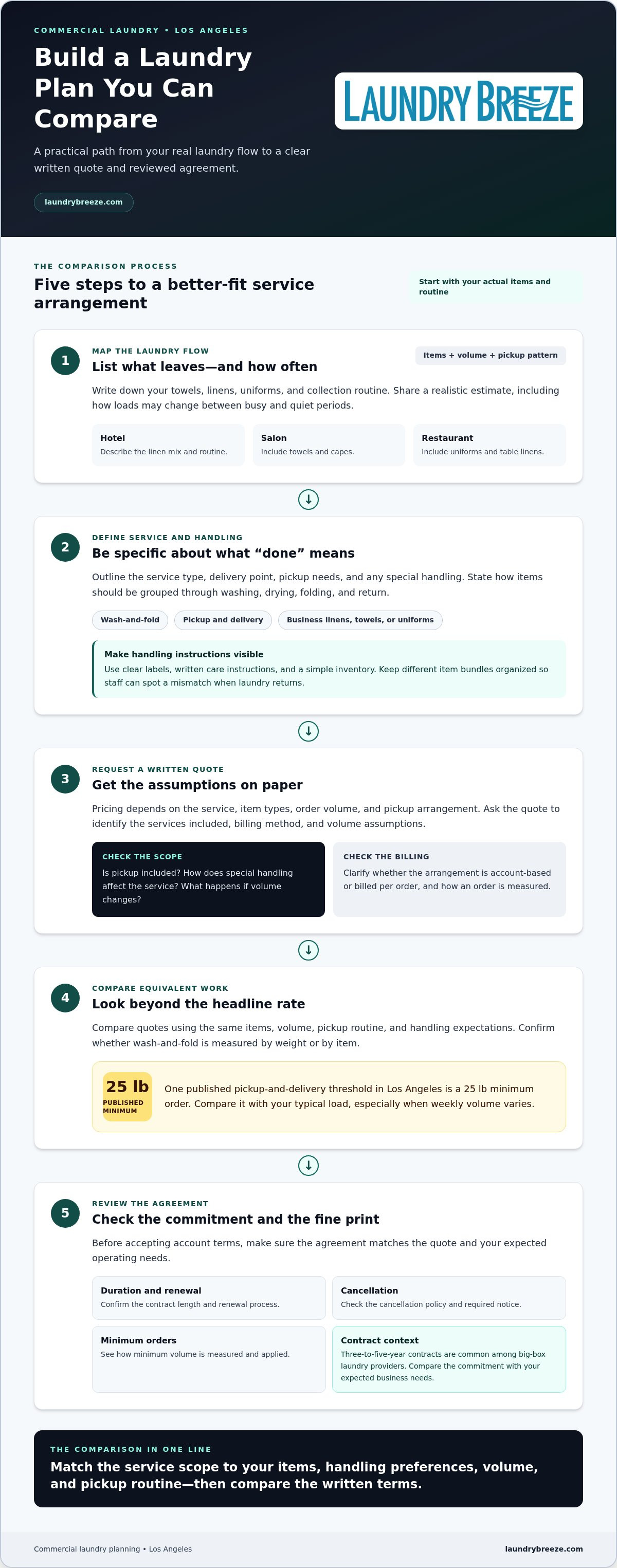
Commercial laundry pricing depends on the service, item types, order volume, and pickup arrangement. A written quote lets you compare the full scope of service rather than focusing on a single rate.
Contract terms, minimum orders, and cancellation policies vary by agreement. Three-to-five-year contracts are common among big-box laundry providers; review the commitment, cancellation notice, renewal terms, and how minimum volume is measured before signing.
Written Quotes and Pricing Models
The price depends on the case and is provided after a quote request; key factors include order volume, laundry type, pickup frequency, and requested handling. Ask for a written quote that identifies the services included, billing method, and any volume assumptions. For a commercial laundry service in Los Angeles, clear terms make it easier to compare an account-based arrangement with per-order billing.
For recurring laundry, share a realistic estimate of your towels, linens, uniforms, and collection pattern. A hotel’s linen mix differs from a salon’s towel loads, so describe the actual items and pickup routine when discussing service. This helps shape an arrangement around your day-to-day operations.
Minimum Orders and Contract Terms
Order minimums can affect the cost of a small or irregular laundry pickup. A 25 lb minimum order is one published threshold for pickup-and-delivery laundry service in Los Angeles. Compare that threshold with your typical load, especially if weekly volume changes between busy and quiet periods.
Wash-and-fold pricing also depends on how the service measures an order, such as by weight or item. Ask for the measurement method and minimum to appear clearly in the quote. That makes it easier to estimate a recurring load of towels or uniforms without assuming every week has identical volume.
Before accepting account terms, read the contract for its duration, renewal process, cancellation notice, and minimum-order rules. A 3-to-5-year commitment can shape operating flexibility, so compare that term with your expected business needs. Keep the quote and agreement together, then check that the service scope and billing language match.
Commercial laundry service for businesses
Los Angeles businesses can outsource laundry instead of asking staff to run a washer between other tasks. The right fit depends on the items, volume, handling needs, and delivery routine. Laundry shouldn’t become the surprise coworker taking over everyone’s shift.
Businesses and Industries Served
Small businesses can use commercial laundry too. A salon may need clean towels and capes, while a restaurant may have uniforms and table linens to wash. Hotels, gyms, spas, and medical offices each handle different items and priorities. Start by listing what your team sends out, then match the service to those items.
Provider Capacity, Equipment, and Specialties
Capacity means more than how many machines a facility has. Consider whether the operation can process your item mix and volume without disrupting your schedule. A gym’s towels and a hotel’s sheets create different workflows. Specialties matter too: experience with uniforms may not tell you how a provider handles spa linens.
Reviews and business references can offer clues about communication, item care, and delivery. Look for comments relevant to your kind of business, not just an overall rating. There’s no single choice that suits every Los Angeles business. A useful reference reflects a similar laundry routine and service need.
California Green Business certification may matter to your sustainability goals, but it doesn’t answer every operational question. Consider it alongside item handling, capacity, and delivery fit. Different questions, different laundry baskets.
Risks include misplaced items, fabric damage, and late deliveries. Clear labels, written care instructions, and a simple inventory help staff spot issues. For example, separate uniform bundles from towels and record what goes out with each pickup. That makes it easier to notice a mismatch when clean laundry returns.
Choosing and Switching Providers
Before choosing a service, list your laundry categories, pickup needs, delivery point, and handling preferences. Compare the service scope with that list. To make the transition smoother, document existing instructions and inventory, then tell staff how to organize outgoing and returned items. A short plan beats a laundry-room guessing game.
Dedicated loads and exclusive use of customer linens
Laundry Breeze never mixes one client’s laundry with another’s. If you need particular items kept together, specify how you want them grouped during washing, drying, folding, and return. A hotel handling branded sheets, for example, can ask for its linens to be returned together and kept separate from other business laundry.
Ask how each order will be identified from pickup through delivery. Use labels, bags, item descriptions, or another agreed method to distinguish your inventory. A spa might separate treatment towels from robes, while a restaurant may keep uniforms apart from table linens. Clear categories make it easier to spot a missing item or sorting issue.
Dedicated laundry handling and linen rental are different arrangements. With cleaning-only service, your business supplies and owns its linens, and the laundry provider cleans them. Linen rental involves linens supplied for use, a separate service model. Make clear that you need cleaning for your own towels, uniforms, or sheets so the service plan reflects the work required.
For bulk laundry, prepare an inventory by type before arranging pickup and delivery. Group similar pieces, note care instructions, and identify items to keep separate. A gym can list workout towels separately from staff uniforms; a hotel can distinguish pillowcases, sheets, and bath towels. These details help establish a practical sorting plan without vague labels such as “mixed linens.”
- Identify ownership: Mark items as business-owned and distinguish them from any separately supplied stock.
- Set load rules: Describe which categories must stay together or apart, such as uniforms and towels.
- Define the return: Specify how clean pieces should be grouped for delivery.
- Track exceptions: Record damaged, stained, or missing pieces when preparing each outgoing order.
Ask for the agreed handling steps in writing, including how the provider will identify your loads and return grouped items. Then test the process with a clearly sorted order, such as separate bags for towels and uniforms. Compare the returned categories with your original inventory and refine labels or instructions where confusion appears. A consistent routine makes bulk laundry easier to receive, distribute, and track across shifts.
Standard and express turnaround times
Turnaround runs from pickup until clean laundry is returned or ready for collection. Wash-and-fold orders can be ready for pickup the next day, and pickup-and-delivery wash-and-fold can include next-day doorstep delivery. These are specific service timelines, not a promise that every commercial order follows the same schedule.
For a business, the key question is which timeline applies to its items and delivery arrangement. A gym that relies on clean towels needs a different plan from a salon processing occasional capes. Before scheduling, list the items, expected volume, pickup day, and date clean stock is needed. This gives the service team a concrete timeline to plan around.
“Express” needs a clear definition in any service arrangement. It may mean faster processing, a different pickup window, or priority delivery, and those are not interchangeable. Ask which step is accelerated and how turnaround is counted. Confirm whether timing starts at pickup, receipt, or processing, and whether delivery is included.
- Set the deadline: Note when staff need the clean towels, uniforms, or linens.
- Map the handoff: Record when laundry can be picked up and where clean items should return.
- Separate urgent items: Identify the stock needed first, such as towels for the next gym shift.
- Keep a buffer: Plan usable inventory around the agreed return date, not an assumed express window.
Turnaround can depend on the amount and type of laundry, handling requirements, and transport between pickup and return. A bulk order of mixed linens may need a different workflow from a smaller uniform load. Share those details when planning the schedule. If demand changes, such as when a hotel expects higher occupancy, discuss the new volume and required return date together.
Set out the schedule in your service plan: pickup timing, expected return, delivery location, and how timing changes will be communicated. Keep a simple record for each load, including its category and the date it is needed. If a delivery misses the expected window, that record helps staff identify which items need attention and adjust the next pickup plan.
For Los Angeles businesses, next-day wash-and-fold offers a useful reference point, while commercial turnaround should reflect the order and handoff. Compare standard and express terms across the full route, from pickup to returned laundry. A clear deadline and item list are more useful for scheduling than relying on the word “fast.”
Customized programs for hotels, gyms, spas, and medical offices
A useful laundry plan starts with your daily workflow. A Los Angeles hotel, neighborhood gym, spa, and medical office may all process fabric, but their items and return priorities differ. List the clothes, towels, and linens each team uses, then set handling instructions around how staff receive and store them.
Hotels: List sheets, pillowcases, bath towels, and staff uniforms separately. Housekeeping may need folded items grouped by type, while front-of-house uniforms follow a different distribution routine. Note where clean items should go and which categories should stay separate. A clear inventory helps keep guest-room linens distinct from staff clothing.
Gyms: Plan around workout towels and employee uniforms. If class schedules change demand, note which towels are used most and when clean stock is needed for the next operating period. Keep staff garments separate from member towels to make receiving and distributing each category simpler.
Spas: Identify treatment towels, robes, and staff clothing that needs laundering. Mark items by room or service area, then specify whether towels and robes should return folded or in another agreed arrangement. Clear sorting notes help staff restock treatment rooms without searching through mixed bundles.
Medical offices: List ordinary office linens, towels, and work clothes separately. Describe each item plainly and explain where clean laundry should be returned. Distinguish routine laundry from items that require specialized handling rather than assuming every fabric follows the same process. Clear categories help the service plan reflect the work involved.
To plan a program, prepare a concise operating sheet with four details:
- Item categories: Name each type, such as gym towels or hotel sheets.
- Handling notes: State sorting and folding preferences for each category.
- Collection routine: Identify where outgoing laundry is placed and who prepares it.
- Return routine: Explain where clean items go and how staff distribute them.
Laundry Breeze: Pickup & Delivery Laundry Service
Laundry Breeze provides commercial laundry service and pickup and delivery for businesses with recurring towels, linens, and uniforms. Outsourcing laundry processing takes it off your team’s task list, leaving staff more time for daily operations.
Use the service when business laundry needs to be collected, cleaned, and returned rather than handled on-site. For wash-and-fold needs or bulky bedding, Laundry Breeze also offers Wash & Fold Service and Comforter & Pillow Laundry Service. Describe your items and handling preferences to define the work your business needs.
For a practical next step, outline your laundry categories, pickup needs, and return preferences. Contact Laundry Breeze to discuss your commercial laundry service needs in Los Angeles, or visit laundrybreeze.com to learn more.
Put a Clear Laundry Plan Into Practice
Turn your laundry needs into a practical routine. Decide which items need regular care, how staff will sort them, and where clean laundry should go. That simple plan can help your business get more from a commercial laundry service in Los Angeles while keeping daily operations organized.
Laundry Breeze offers Commercial Laundry Service and Pickup & Delivery Laundry Service for business laundry. Comforter & Pillow Laundry Service can also handle bulky bedding. Choose the service that fits your team’s laundry and share your preferences so the arrangement reflects your workflow.
Frequently Asked Questions
Do you offer eco-friendly or hypoallergenic detergent options?
Laundry Breeze handles commercial laundry such as towels, linens, and uniforms. If your business prefers eco-friendly or hypoallergenic detergent, state that preference along with relevant items and fabric-care instructions. For example, a spa can identify treatment towels separately from staff uniforms. Clear instructions define the requirements for each load without assuming that every fabric or business has identical needs.
Is there a minimum weight requirement for laundry orders?
The stated threshold for per-pound orders is a minimum charge, rather than a minimum weight. That means a business should consider both its expected load and the order minimum when planning service. Separate heavy items, such as comforters, from regular towels or uniforms when estimating a load, since bulky bedding may follow an individual-item pricing model instead of per-pound pricing.
Which areas of Los Angeles do you provide laundry services to?
Laundry Breeze serves Los Angeles, Beverly Hills, West Hollywood, Culver City, Santa Monica, Venice, and Westwood. Coverage also includes specified neighborhoods and ZIP codes within the service area. Before planning a recurring pickup, identify your location and delivery point, then arrange handoffs around the staff member who receives clean items.
Which Los Angeles commercial laundries serve hotels, restaurants, hospitals, and gyms?
Laundry Breeze provides commercial laundry for hotels, gyms, salons, medical spas, restaurants, and medical facilities. Hotels may need guest linens, restaurants may process table linens or uniforms, and gyms often handle towels. For hospital-specific textiles, align the laundry arrangement with the facility’s handling procedures. Match the provider’s stated industry experience and service scope to the actual items your organization processes.
What are the commercial laundry prices in Los Angeles per pound or item?
Commercial laundry pricing depends on the service, item types, volume, and pickup arrangement. Per-pound laundry and bulky items may use different pricing methods, so compare like with like. A recurring towel order, for example, may be priced differently from individually priced bedding. Request a written quote that describes the work and billing method, then compare it with your business’s expected laundry mix.
Are pickup and delivery included, and what are the service areas and schedules?
Laundry Breeze offers pickup and delivery, with service hours Monday through Sunday, 9:00 a.m. to 7:00 p.m. Service areas include Los Angeles, Beverly Hills, West Hollywood, Culver City, Santa Monica, Venice, and Westwood. Order terms vary by service type, so factor the specific items and delivery location into your operating plan. Assign a staff member to prepare outgoing laundry and receive returns.
What turnaround times do Los Angeles commercial laundry services offer?
Wash-and-fold laundry in Los Angeles can be ready for pickup the next day, and pickup-and-delivery services can include next-day doorstep delivery. Commercial timelines depend on the order and workflow, so plan around your stock needs. A gym can identify which towels are needed for its next operating period, while a hotel can schedule linen returns around room turnover.
What certifications and health or sanitation standards should commercial laundries meet in California?
Don’t treat a certification alone as proof that every handling practice suits your business. Clarify how the service will follow your facility’s item-handling instructions, especially for medical-office textiles. Separate routine items from anything governed by your organization’s procedures, and document sorting and return expectations. This helps your team assess whether the laundry workflow meets its operational needs without assuming one standard suits every industry.
To see links to services mentioned in this article, please click
https://www.laundrybreeze.com


