

Managing laundry in-house takes time away from your team’s core work. This guide explains how a commercial laundry service near me can support Los Angeles businesses and what to consider when arranging service for towels, linens, or uniforms.
You’ll also learn how scheduling and contracts can be structured, which details affect the arrangement, and where to find a provider’s service hours and location information. That way, you can understand the practical steps involved and decide what kind of laundry support fits your business.
Key Takeaways
- Match a recurring pickup routine or a one-time laundry need to your business’s workflow.
- Know which scheduling details and contract terms shape a workable commercial laundry arrangement.
- Identify the kinds of businesses that can benefit from outsourcing laundry tasks.
- Find the location and operating-hours details that help you plan service around your workday.
- Compare turnaround and order requirements with the volume and timing your operation needs.
Commercial laundry scheduling and contracts
A useful laundry schedule connects pickup frequency with how quickly clean items return to work. In Los Angeles, businesses can arrange recurring service or a one-off laundry need, depending on their workload.
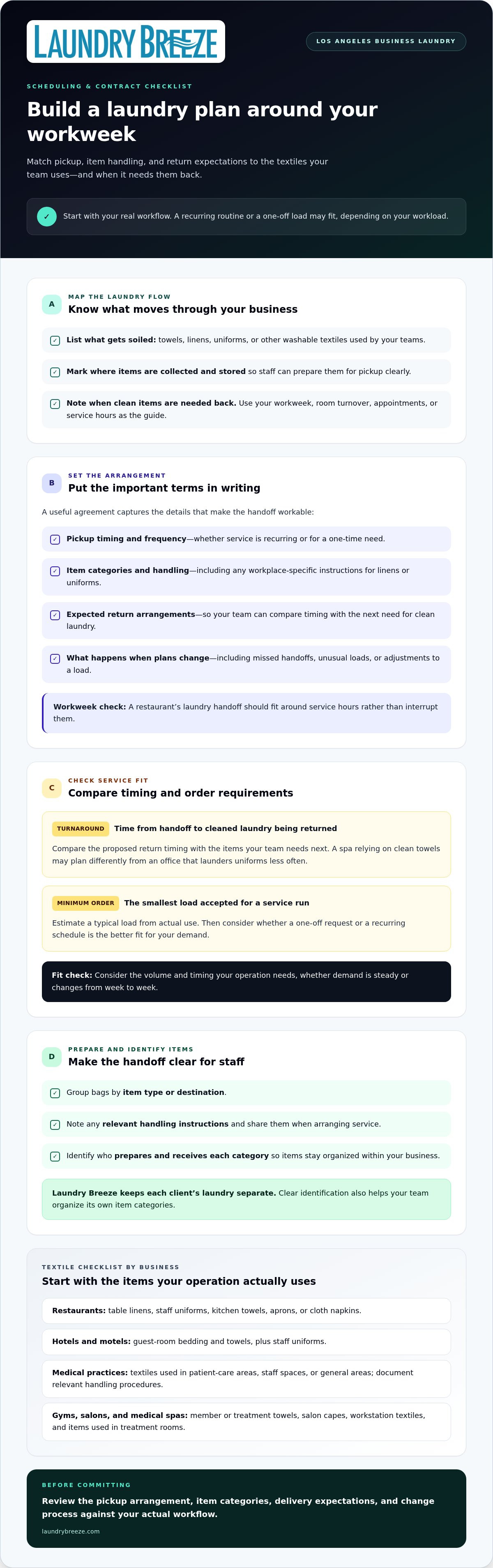
Before setting up service, map out what gets soiled, where it is stored, and when staff need it back. A hotel might plan around room turnover, while a salon may focus on towels and uniforms. These patterns help shape a practical laundry routine.
Scheduling and Contract Terms
Scheduling covers pickup timing, frequency, item handling, and expected return arrangements. A written agreement can record those details, along with how changes, missed handoffs, or unusual loads will be handled.
Review the arrangement against a real workweek. A Los Angeles restaurant, for example, needs a laundry handoff that fits around service hours rather than interrupting them. List the items you need processed and consider when staff can prepare them for pickup.
Turnaround Times and Minimum Orders
Turnaround describes the time between handing over soiled items and receiving cleaned laundry. Minimum orders set the smallest load accepted for a service run. Both terms affect whether a plan suits a small practice, a hotel, or a business with changing weekly demand.
Compare the proposed return timing with the items your team needs next. A spa that relies on clean towels may plan differently from an office that launders uniforms less often. For minimums, estimate a typical load from actual use, then consider whether a one-off request or a recurring schedule fits better.
Commercial laundry requirements depend on the items being processed and how a business uses them. If your workplace has specific handling procedures for linens or uniforms, document them for staff and communicate them when arranging service.
Help staff prepare laundry clearly before pickup. For example, group bags by item type or destination and note relevant handling instructions. Laundry Breeze never mixes one client’s laundry with another’s, and clear item identification helps your team keep its own categories organized.
Keep the agreement practical and specific. Record the pickup arrangement, item categories, delivery expectations, and the process for adjusting a load when business needs change. Then compare those terms with your actual workflow before committing. A well-matched schedule makes laundry easier to plan, while vague timing or unclear order minimums can create avoidable pressure during a busy week.
Commercial laundry customers
Commercial laundry serves businesses that use washable textiles in daily operations. Laundry Breeze provides commercial laundry for hotels, restaurants, medical spas, gyms, and salons, handling items such as towels, linens, and uniforms.
For restaurants, laundry supports both front- and back-of-house work. Table linens and staff uniforms differ from kitchen towels, so list each category your business uses. A café relying on aprons has a different mix from a dining room setting tables with cloth napkins. Keeping the categories clear helps each item stay in its proper role.
Hotels and motels manage textiles used in guest rooms and staff duties. Housekeeping teams use bedding and towels, while employees may also wear uniforms. Start by identifying who handles each category and where it is used. That makes it easier to describe your needs when arranging commercial laundry.
Medical practices should consider how laundry fits into their workplace procedures. Identify which textiles are used in patient-care areas and which belong to staff or general spaces. Document the handling instructions your practice follows, then communicate the relevant details when arranging laundry service.
Gyms, salons, and medical spas also depend on clean textiles during appointments and classes. A gym may use towels for members, while a salon relies on capes and towels at workstations. A medical spa can map textiles to treatment rooms. Listing these categories helps owners identify recurring laundry tasks and plan around them.
When choosing a commercial laundry service for a restaurant, hotel, or medical practice, compare its services with your items and workflow. Describe the linens and workwear you use, how they move through your business, and any relevant handling procedures. Laundry Breeze provides commercial laundry for businesses in Los Angeles and nearby areas.
- List the textile categories used by each team.
- Note where staff collect and store used items.
- Describe any workplace-specific handling instructions.
- Identify who prepares and receives each laundry category.
Commercial laundry service in Fort Collins
For Los Angeles businesses, compare commercial laundry providers by item handling, service arrangements, and fit with your workflow. Reviews can add useful context when they describe communication, consistency, or how a provider handled a service issue.
Comparing Local Service Providers
Start with the laundry your Los Angeles business produces. List items such as towels, uniforms, or linens, then note how your team uses them. A restaurant’s table linens differ from a hotel’s bedding. This inventory helps you describe your needs when arranging Laundry Breeze’s commercial laundry service.
Next, compare the proposed process, not just the broad service description. Consider how items are identified, sorted, and returned, and how the arrangement handles changes in your load. For example, a salon with fluctuating towel use needs a workable way to communicate changing volumes. Clear terms make providers easier to compare.
Consider whether your laundry needs are regular or occasional. A Los Angeles hotel with a steady linen cycle may arrange a recurring routine, while a business with a temporary surplus may need a one-time service. Describe your expected pattern so you can choose the arrangement that suits your use.
Use consistent criteria for each provider:
- Which item types does the service handle?
- How are business-specific instructions recorded?
- What pickup and return process is proposed?
- How can the arrangement adapt when laundry needs change?
Reviews and Ratings
Reviews can show what business customers experience during everyday service. Look for specific examples, such as a provider communicating about a handoff or handling recurring linen loads. A detailed account gives more context than a short rating without explanation.
Look for repeated themes, then relate them to your operation. A hotel may value reliable coordination, while another facility may prioritize clear handling instructions. Note positive and critical patterns, especially comments about communication, item handling, and follow-through.
Ratings are one input, not a complete service assessment. A high score doesn’t explain whether a provider handles your items or workflow. Check the detail and relevance of reviews, then compare them with the service terms. Business-specific feedback can help you evaluate the arrangement more thoughtfully.
Keep your comparison grounded in the work. If a Los Angeles restaurant needs table linens and uniforms, reviews about unrelated household laundry may offer little guidance. Focus on business-relevant examples and the provider’s stated process. Compare those findings with your item list and operating routine.
Los Angeles businesses can also ask how a provider was screened before comparing service details. Laundry Breeze says its commercial laundry partners are prequalified using strict quality and reliability criteria. Treat this as one point to consider alongside how the proposed service handles your items and workflow.
Laundry Breeze ensures its commercial laundry partners are checked for business licenses and quality standards. Keeping these checks in view alongside item handling, communication, and return arrangements can help you compare providers more thoughtfully. Qualification information can inform your assessment, while the proposed service terms and fit with your operation remain important parts of the decision.
Location and operating hours
For a Los Angeles business, distinguish the pickup and delivery arrangement from visiting a laundromat. Laundry Breeze offers commercial pickup and delivery in its service area. Consider how your staff will prepare laundry for handoff and what routine will work for your location.
Use the provider’s official location page to find its listed address and hours. Then compare those details with its business profile and any hours posted at the storefront. For example, if one listing shows different hours from the website, treat the official business page as the clearest starting point and plan around the posted information at the location.
Location matters when planning pickup and delivery. A restaurant in Los Angeles may need staff to prepare laundry for a scheduled handoff, while another business may prefer to drop items off at the laundromat. Laundry Breeze offers commercial pickup and delivery in its service area, as well as an attended laundromat in Los Angeles.
Los Angeles businesses should also distinguish a service area from a storefront address. Beverly Hills, Culver City, and Santa Monica are nearby areas served by Laundry Breeze, but a service-area mention does not identify a customer-facing facility in each place. Use the listed business address for visits, and the service-area details for understanding delivery coverage.
Operating hours affect drop-off planning and staff coordination. Compare listed opening and closing times with your team’s workday, then note any stated differences between weekdays and weekends. For example, a hotel manager can plan a linen handoff around a shift change only if the listed hours support that visit. Don’t assume a pickup schedule matches storefront hours.
- Find the official address and identify whether it is a facility or service-area reference.
- Read the operating hours alongside any weekday or weekend distinctions.
- Match the listed hours to your planned drop-off or handoff method.
- Save the location details where the staff member handling laundry can find them.
For a Fort Collins business comparing local results with a Los Angeles operation, geography is essential. A provider’s Los Angeles address doesn’t establish service in Fort Collins. Match the service location and coverage information to the business address before building a laundry routine around travel or delivery.
Keep the details together in one staff note: the facility address, the relevant hours, and the expected handoff point. For example, a restaurant manager can share that note with the person preparing uniforms or linens. This simple step prevents staff from relying on an outdated search result or confusing a service area with a physical location.
Commercial laundry service turnaround times and minimum order requirements
Turnaround time is the interval between handing over soiled laundry and receiving clean items. Minimum orders define the smallest load accepted for a service run. For a Los Angeles restaurant, both terms affect whether enough table linens and uniforms are ready for upcoming shifts.
The right laundry routine depends on a business’s items, workload, and pickup logistics. A hotel preparing guest rooms may need a different schedule for bedding and towels than a small salon does for towels and workwear. Plan around when staff need clean items and when laundry can be handed over.
To assess turnaround, begin with your own item cycle. List what gets used, how quickly clean replacements are needed, and when staff can prepare laundry for handoff. Then compare that routine with the provider’s stated processing and return schedule. Build in time for sorting and internal distribution, too. Clean laundry still needs to reach the right room, station, or team.
Minimums also shape the fit. A provider may set a minimum by weight, item category, or service visit. Each approach affects a business differently. A restaurant with steady linen use might meet a recurring minimum, while a small office could produce less laundry. Compare the minimum with an actual load, not an unusually busy week.
- Track typical items, such as linens, towels, or uniforms.
- Estimate how often each category needs cleaning.
- Compare actual loads with the stated minimum.
- Match return timing to the next operational need.
Ask how mixed items count toward the order minimum. For instance, a spa may combine towels and linens, while a restaurant separates aprons from tablecloths. Clarify whether separate categories affect sorting or processing. That detail can change how your team prepares each handoff.
Also consider fluctuations. A hotel may handle more laundry during a busy period, while a restaurant’s volume changes with bookings. A practical plan should explain how the schedule accommodates ordinary changes in load size. Record the agreed process so staff can prepare laundry consistently, even when shifts change.
Before starting, write down the expected items, handoff routine, minimum, and return timing. Compare that record with your operating calendar. For example, a restaurant can check whether clean uniforms return before the next planned shift. Clear terms help prevent a short load or mismatched timing from disrupting the workflow.
Laundry Breeze: Pickup & Delivery Laundry Service
Laundry Breeze provides Commercial Laundry Service for businesses that need towels, linens, and uniforms cleaned. Pickup & Delivery Laundry Service simplifies the handoff for businesses in Los Angeles and nearby service areas. Laundry is handled separately for each client, never mixed with another client’s items.
For a hotel, restaurant, or medical practice, commercial laundry can take washing and folding off the team’s daily workload. Laundry Breeze also offers Comforter & Pillow Laundry Service and Wash & Fold Service for those specific needs.
Make laundry easier to plan
Your next step is to map your laundry routine. Note the items your team handles, how they fit into daily operations, and when pickup would work. Then compare those needs with Laundry Breeze’s commercial laundry and pickup and delivery services. A commercial laundry service near me should fit your business location and workflow, not just look convenient in a search result.
For Los Angeles businesses, Laundry Breeze offers Commercial Laundry Service and Pickup & Delivery Laundry Service. Comforter & Pillow Laundry Service is also available for larger items. Explore these services and plan a routine that suits your business’s laundry needs.
Frequently Asked Questions
What do I need to know?
Match a laundry service to your business location, item types, and workflow. A restaurant in Los Angeles may need help with table linens and uniforms, while a gym may focus on towels. Consider how staff will prepare laundry for pickup. Laundry Breeze serves Los Angeles, Beverly Hills, West Hollywood, Culver City, Santa Monica, Venice, and Westwood.
What types of businesses do commercial laundry services serve?
Commercial laundry can help businesses that regularly use towels, linens, or uniforms. Laundry Breeze provides commercial laundry for hotels, gyms, salons, medical spas, and restaurants. A gym may need towels and staff uniforms, while a restaurant may use linens and workwear. List the items your business uses and how they support daily operations.
Do local commercial laundries offer pickup and delivery?
Yes. Pickup and delivery can reduce staff handling and trips to a facility. Laundry Breeze offers Pickup & Delivery Laundry Service for commercial and residential customers in its Los Angeles service area, including Beverly Hills, West Hollywood, Culver City, Santa Monica, Venice, and Westwood. A salon, for example, can arrange pickup and return for towels so staff can focus on their regular work.
To see links to services mentioned in this article, please click
https://www.laundrybreeze.com


