

It’s easy to lose hours sorting, washing, drying, and folding at home. A laundry delivery service can collect and return your clothes, taking those chores off your list. Before scheduling, check the pickup process, billing, and how to share care preferences.
This guide explains how pickup and delivery work, what per-pound pricing and minimum charges mean, and how to communicate laundry preferences. You’ll know what to expect and what to consider before arranging service in Los Angeles, Beverly Hills, West Hollywood, Culver City, Santa Monica, Venice, or Westwood.
Key Takeaways
- Learn the usual steps from arranging a pickup to receiving clean, folded laundry back.
- Understand how per-pound billing works and how a minimum order can affect a small load.
- Share clear washing and detergent preferences so your laundry is handled according to your instructions.
- Compare the kinds of laundry services available and identify which one fits your household or business needs.
- See how pickup and delivery, wash and fold, and specialty laundry options can help take laundry off your to-do list.
Wash, dry, and fold laundry pickup and delivery
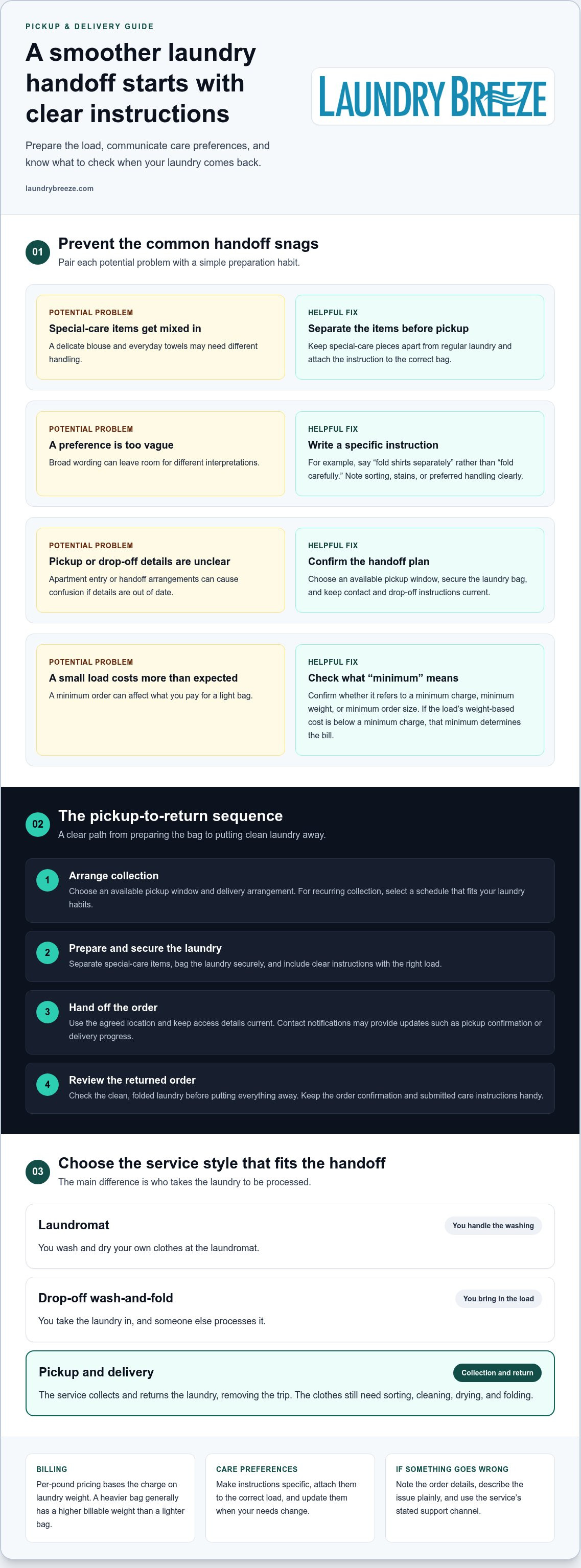
A wash-and-fold pickup service follows a straightforward sequence: schedule collection, prepare your clothes, then receive them washed, dried, and folded. Before pickup, separate items needing special care from regular laundry. Keep instructions with the correct bag so they stay associated with the right items. For example, set a delicate blouse apart from everyday towels and note the care request.
How does laundry delivery compare with local laundromats and drop-off wash-and-fold? At a laundromat, you wash and dry your own clothes. With drop-off wash-and-fold, you bring in the load and someone else processes it. Pickup and delivery removes the trip, while the laundry still needs sorting, cleaning, drying, and folding.
Use these steps to prepare for a smooth handoff:
- Choose an available pickup window and delivery arrangement.
- Bag the laundry securely, keeping special-care items separate.
- Include clear instructions about sorting, stains, or preferred handling.
- Review the returned order before putting everything away.
For example, separate a delicate blouse from everyday towels instead of expecting staff to guess. Clear instructions help distinguish garments that need different care. If the service offers contactless handoffs, leave the bag at the agreed location. Notifications may help you follow order updates, such as pickup confirmation or delivery progress. Keep your contact and drop-off instructions current, especially for apartment buildings with a lobby or entry code.
Scheduling can suit either an occasional load or a regular routine. For a one-time pickup, choose a suitable available window. For recurring collection, select a schedule that fits your household’s laundry habits. Have the bag ready and update handoff details if your location changes. A calendar reminder can help you avoid missing a pickup during a busy week.
Pickup arrangements depend on location, so start with your neighborhood or ZIP code. A resident in Westwood, for example, can look for service covering that area and review its collection instructions and accepted laundry types. The same approach applies in Santa Monica, Culver City, Beverly Hills, Venice, and West Hollywood. Laundry Breeze serves Los Angeles and these nearby areas; review the service details before scheduling.
Customer support
Good support makes it easier to resolve practical issues, from a missed pickup to a folding preference that wasn’t followed. Before placing an order, identify how you can reach the service and where order updates appear. Save the confirmation and any instructions you submitted. If a bag is picked up from an apartment lobby, for example, clear building access details can prevent a handoff mix-up.
A satisfaction guarantee is useful only when its terms explain what happens after a problem. Look for the remedy it covers, the steps for reporting an issue, and any time limit for submitting a concern. A promise to address a missed instruction differs from a promise to redo an entire order. Read the actual wording rather than relying on a broad label such as “satisfaction guaranteed.”
Preferences are easier to follow when they’re specific and attached to the right load. Write “fold shirts separately” instead of “fold carefully,” and distinguish a preferred wash setting from a request to keep certain items apart. If customized bags or labels are available, use them to identify household members or separate everyday clothes from special-care pieces. Keep the instructions consistent between orders, then update them when your needs change.
Customer experiences often turn on small details. Imagine receiving a clean, folded order with one garment missing, or finding that shirts were folded together despite separate instructions. In either case, note the order details, describe the issue plainly, and contact support through the stated channel. A clear message such as “the blue shirt listed in my order wasn’t returned” gives staff something specific to investigate.
Reviews can help reveal patterns, but read beyond the star rating. Look for recent, detailed comments about communication, pickup coordination, folding, and how problems were handled. One complaint may describe an isolated mix-up; repeated reports about unclear updates can signal a process concern. Also consider whether the reviewer describes a situation like yours, such as apartment delivery or separate household loads.
- Save order confirmations and submitted care instructions.
- Record the item and issue if something arrives differently than expected.
- Compare review details, not just overall ratings.
Per-pound pricing and minimum order
Per-pound pricing ties the laundry charge to the weight of the clothes processed. A heavier bag generally has a higher billable weight than a lighter bag under this model. The key details are how the service weighs an order and whether a minimum applies. Before scheduling, check whether the minimum means a minimum charge, minimum weight, or minimum order size. Those terms affect a small load differently.
If your load’s weight would cost less than the minimum charge, the minimum determines the bill. A minimum charge is not an extra cleaning step. Check how a small household load is billed, then decide whether to combine suitable items. Keep delicate garments and items needing separate care apart, even if combining bags seems more convenient.
Flat-rate and per-pound pricing work differently. A flat rate sets a charge for a defined bag, load, or service; per-pound pricing changes with the measured weight. Compare what each price includes, such as washing, drying, folding, pickup, and delivery. A flat-rate bag can make the total easier to anticipate when its size and contents are clear. Weight-based billing reflects the amount processed.
Per-bag pricing is easiest to understand when the bag’s capacity and included service are explained. Don’t assume every bag holds the same amount or that an overfilled bag counts as one standard order. For a fair comparison, use the same clothes and service details when reviewing per-bag and per-pound options. Check how separate bags are billed, especially when fabrics need different care.
In Los Angeles, compare laundry costs using the same load and service details. A per-bag offer and a per-pound offer aren’t directly comparable if one includes pickup and delivery and the other doesn’t. Compare similar loads, then account for the cleaning steps and collection arrangements. Matching the details makes the billing model easier to evaluate.
The final price depends on the load’s weight, selected service, and pickup arrangements, and is provided after a quote request. Review these details together:
- How the laundry is weighed and which weight determines billing.
- Whether the minimum is a billable amount, weight, or order size.
- What washing, drying, and neatly folded return include.
- How separate bags or fabric-care instructions affect the order.
These steps help you compare equivalent services and choose a billing structure that suits your laundry routine.
Cleaning preferences and detergent choices
Clear preferences distinguish routine washing from items needing different care. Before collection, read each garment’s care label and group similar instructions together. For example, put a washable cotton T-shirt apart from a blouse marked for delicate handling. Add a concise note explaining the request and keep it with the correct bag. That makes instructions easier to match to the right clothes.
How should you handle delicates, stains, and special-care items? Separate delicates and describe a stain’s location and cause, if known. Include the garment’s care-label instructions and handling preferences so the laundry team can consider them during processing.
Detergent preferences are another useful detail to communicate. If you prefer a particular detergent type or have a sensitivity, state that clearly with your order instructions. Don’t assume every service uses the same detergent or offers identical choices. Specific wording, such as “please use fragrance-free detergent,” is more useful than a broad request like “use gentle products.” Keep the preference attached to the order, especially if it changes between visits.
Make hang-dry requests specific. Identify each item and say it should hang rather than go through machine drying. For example, place a lightweight blouse in a separate group with its instruction. This distinguishes it from everyday clothes intended for standard washing and drying. Check the care label first, since its directions can guide your request.
Dry cleaning is separate from standard wash-and-fold. Keep items with care labels directing dry cleaning apart from washable laundry. A suit jacket is one example; placing it loose in a regular laundry bag can obscure the requested service. Sort and identify those garments clearly so the cleaning method matches the care label.
Bedding also benefits from clear sorting. Sheets, pillowcases, comforters, and pillows differ in size and fabric, so identify each type rather than grouping everything as “bedding.” List a bulky comforter separately from a set of sheets, share care-label directions, and note any special handling requests. Separating bedding from clothing also makes instructions easier to follow.
Before the next pickup, use this short checklist:
- Read care labels and separate delicate or dry-clean-only garments.
- Identify stains by item and location.
- Write detergent and hang-dry preferences in direct language.
- List comforters, pillows, and other bulky bedding separately.
These steps make your preferences precise and help keep special instructions with the right items.
Which laundry delivery services are available in the United States?
Laundry delivery services vary by location and the type of items they handle. The right fit depends on what needs cleaning and how much work you want handled. Everyday clothes may suit wash-and-fold pickup; a suit may need dry cleaning instead. In Los Angeles, Beverly Hills, West Hollywood, Culver City, Santa Monica, Venice, and Westwood, check the service’s options and pickup arrangements.
Wash and fold: This service covers routine clothing and household laundry. The service collects a bag, washes and dries suitable items, folds them, and returns the order. A household might send everyday shirts, socks, and towels together while keeping delicate garments separate with care instructions. Check the service’s eligible items and minimum charge.
Dry-cleaning collection: Laundry businesses may offer pickup and return for garments needing dry cleaning. This suits items such as a suit jacket or a dress with a care label directing dry cleaning. Keep those items apart from standard washable laundry and identify them clearly when arranging collection. This helps match the service to the garment.
Bedding and bulky items: Comforters, pillows, and other large household pieces may be handled through a separate service. Tell the laundry service what each item is, since a comforter takes up more space than a pillowcase. Check the care label and note any special handling requests. Separating bedding from clothes also makes the order easier to describe.
Commercial laundry: Businesses may need recurring cleaning for towels, linens, or uniforms. A salon can have a steady flow of towels, while a lodging business may process sheets and other linens. Choose a service suited to the items and workflow involved. Identify the textiles and collection routine your operation needs.
Delivery arrangements vary by location. Some services cover specific cities or neighborhoods. In Los Angeles, begin with your neighborhood or ZIP code, then review service types, pickup arrangements, and item requirements. A service for everyday clothes may handle specialty items through a different process.
Use this quick matching guide:
- Everyday clothing and towels: look for wash-and-fold processing.
- Care-label dry-clean garments: choose a dry-cleaning service.
- Comforters or pillows: find a service intended for bulky bedding.
- Business towels, linens, or uniforms: consider commercial laundry.
Laundry Breeze: Pickup & Delivery Laundry Service
Laundry Breeze gives households in Los Angeles, Beverly Hills, West Hollywood, Culver City, Santa Monica, Venice, and Westwood a way to hand off routine laundry. Pickup & Delivery Service collects and returns your laundry, while Wash & Fold handles everyday clothes. Comforter & Pillow Laundry Service covers bedding, and Commercial Laundry serves businesses with towels, linens, or uniforms.
Choose the service that matches the load: everyday clothing, bulky bedding, or ongoing business laundry. Then prepare any care preferences and pickup instructions so they stay with the right items. This is a convenient next step when washing, drying, and folding take time you’d rather spend elsewhere.
Make Laundry Easier to Fit Your Routine
Start by deciding which laundry task you’d most like to hand off. A household load, bulky comforter, or business linens each calls for a suitable service. Choosing one starting point can make trying laundry delivery manageable without changing your whole routine at once.
Laundry Breeze offers Pickup & Delivery Service for laundry that needs collection and return, Commercial Laundry for business items, and Comforter & Pillow Laundry Service for bulky bedding. Choose the option that fits your load, then share the relevant care instructions when arranging service.
Frequently Asked Questions
What do I need to know?
Match the service to your laundry, then consider its collection process, care options, and billing method. Local coverage matters: Laundry Breeze serves Los Angeles, Beverly Hills, West Hollywood, Culver City, Santa Monica, Venice, and Westwood. Decide whether you need routine clothing care, dry cleaning, or help with bulky bedding. A clear item list makes it easier to choose a service and prepare useful instructions.
How does laundry delivery service work?
A laundry delivery service collects your bag, processes the laundry, and returns it to your chosen delivery location. Laundry Breeze washes, dries, folds, and returns the order, and never mixes one customer’s laundry with another’s. For a smoother handoff, identify special-care pieces and make delivery instructions clear, especially in an apartment building or shared entrance.
What is the typical turnaround time for laundry pickup and delivery?
There is no single turnaround time that applies to every laundry service. Timing depends on the service selected and its collection and delivery schedule. Laundry Breeze’s pickup and delivery hours are Monday through Sunday, 9:00 a.m. to 7:00 p.m.; those are operating hours, not a promise that every order takes the same time. When planning around work clothes or bedding, schedule with your needed return date in mind.
How do I schedule a laundry pickup and prepare clothes for collection?
Schedule a pickup, prepare a closed laundry bag, and provide clear handoff instructions. Separate items needing different care, such as a delicate top and everyday towels. Note detergent preferences, hang-dry requests, or stain locations with the relevant item. For a gated building, include entry and drop-off details so the driver can find the right collection point.
What should I know about lost or damaged items and service guarantees?
Keep your order confirmation and note any special instructions before collection. When laundry returns, compare the items with your order and inspect garments for visible damage. If something is missing or affected, record the item and describe the concern promptly through the service’s support channel. Guarantees and remedies vary by business, so read the specific terms before ordering rather than assuming a particular replacement, refund, or re-cleaning outcome.
To see links to services mentioned in this article, please click
https://www.laundrybreeze.com


